


WST - “Welcome to Pan In New York. This is the series called 'When Steel Talks' where we meet the movers and shakers behind the pan scene here in New York and we hear from interesting people on pan; that is the pan players, arrangers and directors. This time around we are happy to have Garvin Blake - a major talent, pan player and arranger. We would like to get into a little bit of you first, Garvin, before we get into the other stuff. I understand that you arranged for Pan Rebels and that band came second. You also arranged for Despers USA, which also came second on one occasion. Not only that, but you are also a soloist and on your recent project Belle Eau Road Blues you played with an impressive group of musicians. You have the respect of music giant Max Roach, who referred to you as a major talent. That is really a great tribute coming from someone such as Max. You have also been lauded by Rudy Smith a.k.a. “Two Left” - a player and arranger who has made tremendous contributions to the world of pan.”
Garvin B. - “First of all it is an honor to have artistes who I look up to, think that way of me- bestow these kind words on me. It really is an honor. It can also be a burden too, cause if you did this- I appreciate the kind words of these individuals you mentioned, whom I consider true giants.”
WST - “I did not have time to go into the others-”
Garvin B. - “Okay, I appreciate the honors.”
WST - “Tell us how long you've been a member of the New York pan movement, what are the pros and cons, tell us what you've seen, what progress you noticed?”

Garvin Blake
Garvin B. - “I have been involved officially since 1975 - that's a long time, unfortunately a lot has changed, and a lot has stayed the same. In terms of youth involvement, there is a lot more youth involved - that's definitely a plus. When I started in 1975, I was one of a handful of teenagers involved. Now I guess seventy-five percent of the bands tend to be kids. That's good and bad. We have a lot of kids participating in the artform which is needed for sustenance of the artform. But it is also a reflection that a lot of the adults don't choose it as a viable way of either expressing themselves professionally, socially, culturally, so that in itself I would not consider positive. The fact that guys in their thirties and forties think that-”
WST - “That's not where they want to be at this particular point in their life.”
Garvin B. - “Right. They are not willing to make that kind of sacrifice. So, it is kind of good and bad. So it has changed as far as the youth being involved.”
WST - “Maybe-”
Garvin B. - “So it is good you got a lot of first generation Americans involved. Basically people from Trinidad or people born somewhere in the Caribbean play it now. I think fifty percent of the kids that play weren't born in Trinidad, eighty or probably more than that.”
WST - “It is a very strong West Indian parentage- but New York based- presence among the youth.”
Garvin B. - “Right.”
WST - “That really leads me right into the next question. Partially you have explained why maybe so many of your peers, who, when you started playing were considered great pan players at that time have chosen now not to continue playing pan and are out of the sunlight. They are just spectators at this point-”
Garvin B. - “The question is why-”
WST - “You've answered it in part to say pan has moved forward per say, in as much as it could have been based here in the media capital of the world.”
Garvin B. - “Right. And that's a tough one to answer. I guess if I could answer that that would be a major breakthrough. One of the problems you have is, pan in New York goes through cycles of organization and disorganization. And that instability more or less forces people to make decisions. People have other life commitments like your landlord, your kids whatever. And in the disorganization, pan in New York always seems to end up in a state of chaos. As you grow older your time becomes more precious. A lot of people say 'I look like I am thirty-five-'”
WST - “Pan becomes the casualty-”
Garvin B. - “Right. It's unfortunate, because there are a lot of brilliant musicians who actually committed a lot of time, but the movement never got to where I guess they thought it should be, and they are partly the cause of it, because we are the movement. It is not an external person to point at. Collectively, I don’t think we were ever able to get this genre really organized and get our priorities straight. I think pan in New York- and in Trinidad to a certain extent- is more a social thing than a musical thing. So when you’re a teenager, socializing is a major part of your life-”
WST - “It is an expression at that point-”
Garvin B. - “Right.”
WST - “Then it becomes more like a dedication.”
Garvin B. - “A lot of times the bands themselves don’t offer an adult that kind of environment to explore themselves at the deepest of musical levels. So a lot of guys pull aside, do their thing individually or go on with life. There are a lot of beautiful things to do in life outside the pan world.”
WST - “Okay, with that in mind how have you managed to balance out? You have a family life and yet you maintained your passion and your love for the pan. It did not happen to you.”
Garvin B. - “Well I think it happened to me to a certain degree. I guess I am one of the folks that stepped out of the ring- so to speak- 'cause pan itself is like a fight. So I’ve stepped out of the ring, but I am still ringside looking in. So as you would say- I guess to paraphrase Bradley- although I am involved in the pan, I am not as committed at times as I would like to be. I’ve made certain decisions in life and that has forced me not to do music as a full commitment, and that’s for a lot of factors. A lot of it is personal. But I am always- pan is something that I’ve been around since I’ve been born. It is always there. So I will never be totally removed from it. I will always be connected. Even if I am not arranging, I am somewhere on the scene giving advice to someone younger than me, or playing gigs as an individual trying to make some contribution to the movement. It is one of the things I enjoy doing, so I am not going to let that go so.”
WST - “Who have been some of your role models, your musical influences, not necessarily only in pan. What makes the total Garvin Blake?”
Garvin B. - “Huh! That’s a tough question. I guess musically- probably one of my earlier role models and probably still a role model to a certain degree- I am not quite sure as you get older if you still have role models, you probably have people you respect. But earlier on in life, my cousin David Maundy, he played with Pan Am North Stars and we lived basically across the street from each other. He was always at my house and he had pans- and there it began. He is not playing today. He chose the road I took. But he is probably less involved. He is one of the greatest pan players I’ve ever heard, and I’ve heard a lot of them- and I guess his discipline and commitment to pan struck me at an early age and it’s like one day I am going to be able to play like this-”
WST - “So it’s like you brought the discipline to the artform while growing up?”
Garvin B. - “The irony is that thirty-five years later, I still cannot play like him, but that’s cool.”
WST - “He had very many years ahead of you. I am sure, the more you work on it, you’ll get there. If you had to choose a band that you think would be able to best express yourself as a voice, where would you start?”
Garvin B. - “It is not for me to say. I wouldn’t want to name a particular band. I would more- it’s like certain environments would allow me to express myself more freely than others. So I can’t really choose a specific band to say this band would play the music. Bands change from year to year. The name stays the same. You know I could call a bunch of bands that change players and still keep the same name.”
WST - “Players move on”
Garvin B. - “Right!”
WST - “Different voices-”
Garvin B. - “I mean anywhere people are open to new ideas, and old ideas- because I believe music is a balance of the old and new- and are committed to making music and not necessarily committed to winning stuff. Winning I think is a by-product to creating good music. Being in an environment where your sole purpose is to win, I don’t think at this point in my life it is such a good idea. At this point it is not healthy for me. I like to be in an environment where people are committed to music, and unfortunately I am not sure I am seeing a lot of bands especially in New York that are really committed to playing good music, not saying that they do not play good music. I don’t think that’s their focus. They happen to play good music because of sometimes by coincidence, sometimes they got a great arranger, or they got good pans, but I don’t think the band themselves are committed to playing good music. Because if you change the arranger or couple of key things change and the commitment of the band is not there and -”
WST - “So what are you saying by and large then, about the general pan scene here in New York?”
Garvin B. - “I think for the most part- and this is generalizing, so I wouldn’t say all bands- it is a very social scene. Music is there, and there is a great percentage of individual players that are into music. But I think by and large, the pan scene in New York is like a social thing, and that’s not bad. It is something for a kid in the summer, whereas they could be on the streets and there are a lot of positives to it. I mean a guy like Bradley is deeply committed to music, but not necessarily everyone in his band is deeply committed -”
WST - “Or share his vision-”
Garvin B. - “Right! They will probably share in the joy of the music-”
WST - “And the winnings”
Garvin B. - “Right- and the winning, which I think is the driving force in New York and probably in Trinidad to an extent. I am not there but I think it is more like a social scene and that is important to keeping the culture alive. It is not necessarily a musical environment as it could be, which I guess is okay too. Because pan represents a people. So even if the music is not the focal point, keeping the people and that legacy going, so there is still some merit in that approach I guess.”
WST - “The drawback in that approach would be the fact, that, once we want to take pan to where we’ve been trying to for however many years, and continue to work towards pan being internationally known and considered viable- would the legacy of people looking at it socially and it being a community thing, would that also present a drawback in that scenario?”
Garvin B. - “Right! Therein lies where, as individuals mature musically, a lot of them don’t see the steelband as a viable means of expression. It is not a balance in terms of the people that come together. People come for various reasons. You may have one guy that’s deeply committed to his music, which is good. Another kid is coming because he needs something to do for the summer, which is also a legitimate thing. So I think we need places like that so there is a conflict - and therefore I see the steelband, especially in New York, not necessarily moving forward musically. The bands are getting bigger and I think they’ve gained some recognition. Whether the recognition is what everyone would like, you know that’s up for debate.”
WST - “And that’s also affecting the general standard then of what it could actually be.”
Garvin B. - “Right! I think the jeopardy in having environments like that is that you have some kids who could have been really great musicians, but they’re in an environment that is not really-”
WST - “Nurturing.”
Garvin B. - “So they go through their normal Panorama thing, do their thing because-”
WST - “And they treat it exactly like what is being put out to them - a social thing. You pass the time, you get with the bands, and you play Panorama because that is the focus.
“If you have anything to do during the year, pan falls by the wayside and you move on. That is the youth part of it. Then you get into the part as you say- the adults, depending on the focus at the time it changes, and you do indeed. For instance some of your peers who no longer plays right now, you loose the expertise, the dedication and -”
Garvin B. - “Which is a sad thing. I was fortunate in that I was involved in pan in New York when the older guys were involved-”
WST - “That was the beginning of pan in New York-”
Garvin B. - “The beginning. That’s why I was able to have people to look up to and say, "okay this is how the drums supposed to be played." And you know-”
WST - “But there is always a great beginning in a lot of stuff. But it is the carrying on the 'carrying through’-
Garvin B. - “Right.”
WST - “You have arranged at least on four occasions. You have not arranged for a while, what will it take to get you back? What are you waiting on?”
Garvin B. - “I am not really waiting on anything-”
WST - “it was badly put- but when will we see your expertise in that light again?”
Garvin B. - “It is hard for me to say when I will get back to arranging. But I believe one day I will probably arrange a Panorama tune again if the environment is right. But it is not something I am really focusing on at this point in my musical life. Maybe one day I will get a chance to do it.”
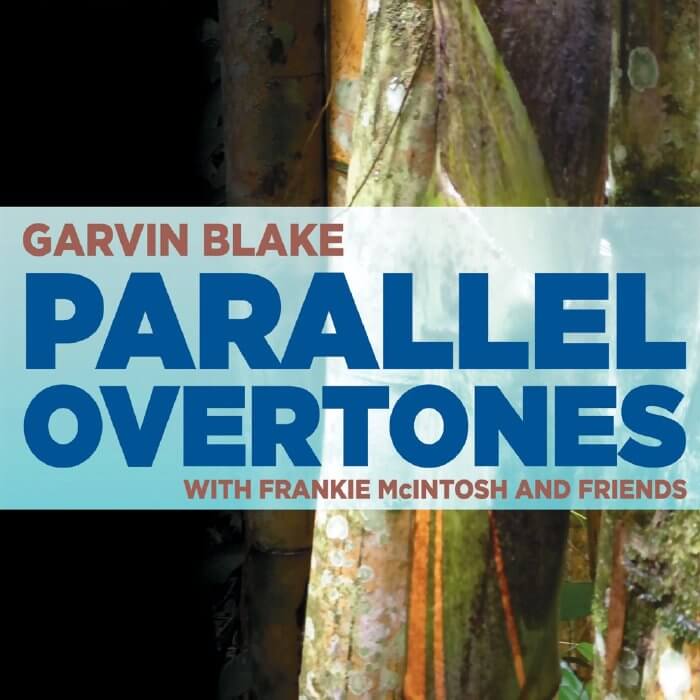
WST - “You’re concentrating a lot on your pan solo work right now. You recently released a jazz flavored CD 'Belle Eau Road Blues’. You have a lot of fabulous performances on that. You have people who played with Paul Simon on his Graceland LP; people like Tony Cedras, Bakhiti - he is a South African bass player, considered by some to be the greatest in the world. You have David Rudder; he did some work for you. Frankie McIntosh on keyboards, he has played with anyone who is listed in the whose-who in soca. You just had lovely vibrations there. It is highly acclaimed, what was that experience like?”
Garvin B. - “That was like- first of all that was an honor. It is something I never thought would come to fruition. I’ve always wanted to do an album, because I think it is important to at least leave a legacy that folks coming behind you could hear. In terms of how the album turned out, the musicians that participated on it, I am kind of awed; I don’t know why they want to play with Garvin- I am always still humbled by that. Guys like Frankie McIntosh; he is a great musician. So it is an honor and I really appreciate those guys supporting me in that effort.”
WST - “When, and would you consider working in a pan ensemble as opposed to working in a pan combo which you have done as well in addition to your solo work.
Garvin B. - “When you say pan, you mean all steeldrum?”
WST - “Right! Not the big band situation as per New York size but a small intimate pan ensemble.

Garvin Blake & Ensemble on stage at Alice Tully Hall, Lincoln Center
Garvin B. - “That something I’ve thought about doing. I guess the issue there is getting with musicians that you feel a kindred spirit. That you feel you’re kind of heading in the same direction to do it a lot of times. That’s really difficult where you may feel you want to go musically. It is not easy to find pan players with the same vision. There are a lot of skilled guys out there, but they kind of want to go a different way with their music. So at this point I haven't really been exposed to that. 'When Steel Talks' with Trevor John- that is an initiative that we kicked off with varying degrees of success. Maybe that whole idea might come back.”
WST - “It provides an impetus because not only will people know it is Labor Day, it's Carnival time - but there is the New York pan scene! There is a lot more that goes on behind the scenes. Pan is not only for soca or Labor Day. But it is an instrument in itself and it should get the respect and recognition it deserves. What types of music would you like to put out on pan? I know you did some soca and you spoke about your jazz CD, what other music styles do you have or would like to be involved with?”
Garvin B. - “Yes, I think pan is really an... it's like anything else. It is an instrument. So I think what really drives what the instrument can do is the individual and not the instrument itself.
I think that the creators of pan- which I can stay here for ten hours naming all the people who contributed to some form of that- I think that they developed an instrument that is certainly viable. The instrument is no doubt legitimate. I think now is just for individuals to play it and express themselves however they want. At this point I have done some calypso stuff for big conventional steelbands. I have done some jazz stuff. But - to me any music could be played on pan if that's how the musician feels. Right now I am just focusing on improvised music. I want to get to the point where I just play the things that I hear in my head and feel in my heart. Whether it is jazz, whether it is whatever. I consider it music. So I don't really want to get locked into any one particular thing. My musical style is really eclectic. I draw from anything, whether it is Monk or Machel Montano. To me it is all music and it is how you internalize it and convey it. So I don't really have any - to say I want to do reggae or hip-hop. I just want to - express and play freely.”
WST - “- express...”
Garvin B. - “Yes, I just want to play free - whatever-
WST - “-and then your influence must be reflected - makes sense.”
Garvin B. - “Right.”
WST - “When it comes to arrangers, some arrange for more than one band in the competition and they do quite well. Sometimes arrangers work with three bands bringing home kudos per say. How do you feel about that? Do you see a conflict of interest there? Do you think that an arranger can do his or her best if they are arranging for four or five bands, sometimes doing the same song for more than one band? How do you feel about that?”
Garvin B. - “I am not sure if the aim - that's a really tough question in terms of -”
WST - “It is not something that you do?”
Garvin B. - “Can an arranger do his best? -”
WST - “but I am not asking to get your take -”
Garvin B. - “I think that an arranger can do great work arranging for five bands and do bad work arranging for one band. So I don't think it is necessarily the amount of bands an arranger works with. There are definitely some time constraints that can work against an arranger. I think it's really up to the band themselves if... - being an arranger - if I work for two bands, and these guys really disciplined and committed to playing music, and if I had the time to really do it - the arrangers don't really need that much time.
I think the keep-back is more the bands than the arrangers. So I think it could be done, but I think it is a decision the bands themselves should make. They should do some self-assessment and see if this guy is arranging for two bands, and he is arranging for - I'll pick a band - WITCO Desperadoes one of the great bands - and I am a little band and have the same arranger, it is not that the arranger will be dedicated to your music. It is just that when he goes to the major orchestra, he is going to get a certain kind of commitment. So the fact that they are giving him more, goes back to the whole environmental thing. So even if he creates beautiful harmonies on his keyboard, in his head... or his heart then goes out to the little band -”
WST - “and he gets that vision, feedback -”
Garvin B. - “so it is not necessarily - yes that feedback - I think where you have arrangers that arrange for bands that are on the same level they tend to both do pretty good. So it is up to the bands. So I think that kind of - I don't know if the question is, should a band - should that be allowed? I think its up to the individual band. A band needs to know what they want, if they want a big name arranger, but they know they have small time players and instruments -”
WST - “if they want to do it then they...”
Garvin B. - “then they do it - I don't think - don't limit the musician. He is doing his work. If they want to go that route - Once they can do it then they are - 'cause I think ultimately, if we want to go into this Panorama and arranging thing, the bands win Panorama, not the arrangers. I think that has been proven time and time again. A good band could win Panorama with mediocre music. And a great arranger with good music and a mediocre band, never wins or rarely ever wins. I mean if you go through the annals of Panorama in Trinidad, you have great arrangers with mediocre bands not winning. You have great bands with - I would not necessarily say mediocre arrangers -”
WST - “competent -
Garvin B. - “competent arrangers but with great players, great techniques, can take the music and -
WST - “take it, run with it -”
Garvin B. - “moves it to the next level. So Panorama is really won by players not arrangers. Arrangers give you the tools. You got to go out there and do what you do.”
WST - “You being a pan player yourself, having played in Panoramas, I am sure you know what you're talking about.”
Garvin B. - “Yes. It is certainly my opinion. I feel strongly that bands win Panorama and not arrangers. Arrangers certainly facilitate you winning. But in a matter of two or three points, the band is what gets you those additional points and move people. It is really a human expression, and at that point it's humans playing. Music is something you really can't touch and feel but -”
WST - “it is what comes out -”
Garvin B. - “Right! And that comes from individuals playing.”
WST - “What about the pan players themselves, when they play in more than one band in the competition. For instance, you have one or two players who play in two or three bands. What's your take on that?
Garvin B. - “My take on that is, to me it is up to the bands to make that same assessment. Is this guy who is playing in two bands playing the music accurately? With emotions? With integrity? If he is doing that I'm fine. 'Cause I will rather have one guy playing in ten bands, if he can come Panorama night and play the music with integrity and is accurate with his phrasing and notes. Than to have one guy who is there all carnival and he is skating - to use a pan term. So I think the bands need to assess that. The guy could play in a million - he comes there, he is playing accurate - I don't think music should be based on attendance, you know.”
WST - “So you don't see a conflict of interest. Once he is delivering. It's okay.”
Garvin B. - “Right. And the bands need to assess that. They should not let the pan players assess that. The bands need to say or maybe the bands say, every night I need all my players and that could be - you know there is some merit in saying every night I want to see one hundred players. And if they decide they want one hundred players and you got to be there from nine to twelve then that would necessitate one guy playing in one band.”
WST - “What do think about this year's Panorama? Did you get a chance to listen? Were you at the competition?”
Garvin B. - “Yes. I was there.”
WST - “What's your personal opinion?”
Garvin B. - “Personal?”
WST - “It's a wide open question.”
Garvin B. - “So wide, yes. I mean Panorama in New York is always - umm - interesting. And a lot of times - I wouldn't say always - disturbing. At the same time, one of the things that is disturbing in Panorama is that the audio is always bad.”
WST - “There were lots of problems this year and most people we've spoken to - in fact all - with one resounding voice said pan people were short changed this year, simply because the sound system stunk - ”
Garvin B. - “Right - ”
WST - “and there is no nice way of putting it - ”
Garvin B. - “and I am not so sure if there was ever a year that the sound system was ever adequate.”
WST - “this year seems to be pretty bad.”
Garvin B. - “So that was really disturbing. In terms of things that I thought were encouraging, there were a couple of new voices, at least one new voice I heard on the scene. What's the guy's name? Someone told me Lord Nelson's son - he arranged for the band Adlib in Long Island. I thought they played creative music. I thought that was interesting. Clive Bradley is always an interesting arranger. He takes the music in a direction - that we say okay - something that I always appreciate. But then I am probably biased, because that's the music I grew up on.”
WST - “But you can express your opinion. So biases are accepted.”
Garvin B. “So, for more or less, Panorama in New York has some clichés that happen year in year out so this year was no different. Clichés kind of happen, so all in all it was enjoyable.”
WST - “Were there any surprises you think in the actual results in this year's competition?”
Garvin B. - “Being involved in New York Panorama for a long time, the results never surprise me.
WST - “So it's more like expect the unexpected?”
Garvin B. - “Yes. I don't know if this year is anymore surprising than anything else. CASYM won for the first time, which I guess, is okay. When I go to Panorama, I really do not concern myself with the results. I view it, as the people who are judging are individuals just like me. They have biases, likes and dislikes. So I hear the music, enjoy what I enjoy, stuff that I really don't care for I hear it and move on. So I really don't get into too much assessment of the results per say. The judges' decision is final. Let's move on.”
WST - “You taking the fifth?”
Garvin B. - “No! I am not really taking the fifth. I don't really want to get into what wins Panorama and what doesn't win. I go there and enjoy the Panorama. Because at New York Panorama, there is always something disturbing. I've been in New York's Panorama. I've played in one, played and lost. Arranged. Never won as an arranger, but was right there somewhere in the mix and it is always disturbing. Even when you do good it is disturbing. When you do bad, it is disturbing. So I am - that's is the nature of anything as subjective as trying to judge - I guess art. So I am trying not to really critique that too much. But I don't really know who the judges are or what's the criteria. There are certain things I hear I enjoy it, and try to take it back with me. There are also certain things that may not really hit me the way the arranger thought it would hit people. I kinda move on from that, go home and get ready for J’Ouvert.”
WST - “Do you ever see yourself playing again in a band just for the experience?”
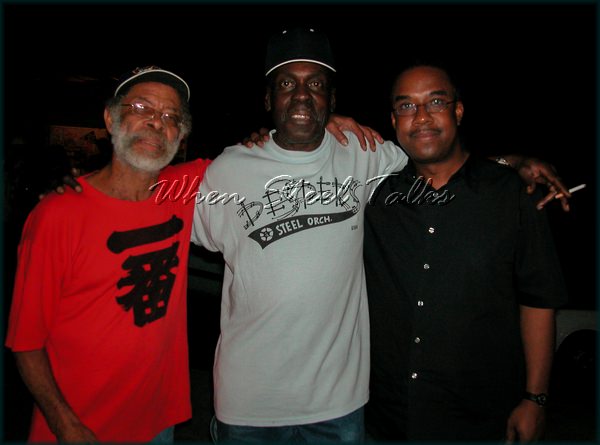
Clive Bradley (left), Emmanuel "Jack" Riley with Garvin Blake
Garvin B. - “Yes. Definitely. Well this year I was contemplating playing, - it hit me that I really wanted to play - and then - the whole panyard environment, the commitment, the whole social aspect. Me personally? Like you ask the question about playing in two bands. Me personally, I am only going to play with one band. I feel I need to be there from nine to whenever -
WST - you want to make that commitment just to -
Garvin B. “The commitment is to be always there when the band is rehearsing. And I really did not see myself giving that kind of time, as opposed to be going and skating through a Panorama song. I say it is more fun for me to go around and listen to the bands. But I definitely thought about playing this year. Definitely I am going to play a Panorama song. It is one of the things I really enjoy doing.”
WST - “Maybe if you get into it again then maybe some of your peers who have been sidelined may say, "hey, it's not such a bad idea after all". You may have some company.”
Garvin B. - “My peers are kinda old. I don't know if those guys will ever come back”
WST - “Well, maybe you'll find that it really hits them- that all the years and all the changes in family life- will all of a sudden just get left by the wayside and their teenage years will come on back...”
Garvin B. - “They might be able to come out - my friends - and maybe they probably can't come out. But yes, I definitely want to play a Panorama song again. I think Godwin Bowen wrote a song, it is like Ten Minutes of Glory. So it is something that you really cannot explain to someone, unless you've been there. So it is definitely something I plan to do again.”
WST - “On plans, when will the next CD be out? Are you working on one? Are you planning one?”
Garvin B. - “I am always planning to do some sort of music and try to publish it. In terms of a date, I don't have a date. What I hope to do is start playing a little more which has been picking up, try to get Belle Eau Road Blues out there more. I really haven't given that an honest effort in trying to get that music out. Soon as that is done, once that gets - ”
WST - “promoted”
Garvin B. - “going -”
WST - “it will propel you to -”
Garvin B. - “Right. But I definitely have some thoughts on what I would like to do next. And hopefully the next two years I should be back.”
WST - “Let's look further than two years. What's down the road for Garvin Blake? Let's say ten years from now. What sort of perception and goals would you like?”
Garvin B. - “I just want to keep growing as a musician, as a person. I find it can go hand in hand. As you grow as a person, it reflects in the growth of your music and vice versa -”
WST - “yes, because it is coming out of your experience in life.”
Garvin B. - “So I just want to keep growing and try to stay honest to the music.”
WST - “You know what? You can only go further. You can even grow even stronger and fuller. And based on comments like that from Clive Bradley, there is no stopping Garvin Blake at this point. So just imagine if you were to get into it (music) more, what you would accomplish.”
Garvin B. “Yes! But the irony is I might get into it more and produce less. So I am not really sure. I probably would do more. -”
WST - “whichever niche you take, it is going to -”
Garvin B. - “I am going to keep doing what I am doing and try to make some contribution to this great artform.”
WST - “It's been really great - ”
Garvin B. - “Okay, thanks a lot.”
WST - “To have you here on When Steel Talks, and we look forward to hearing a whole lot more from you.”
Garvin B. - “Okay thanks a lot.
WST - Thank you very much. Thank you for joining us here.
Leave a comment in the WST forum
 When Steel
Talks shirts
When Steel
Talks shirts