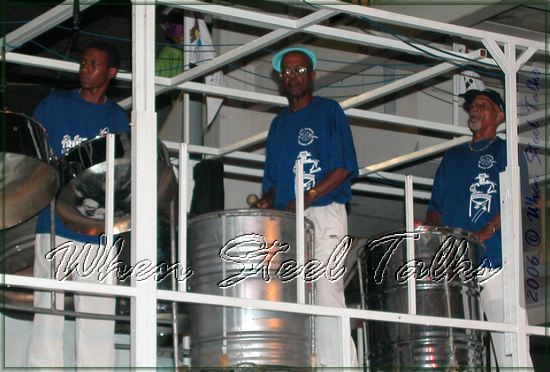
St. James Tripolians
Steel Orchestra has been in existence
for over 38 years. Founded near
the end of 1971 by Emmanuel “Manuel”
Camps, the band was on the road
for Carnival 1972, playing
All Day,
All Night, Miss Mary Ann and
Drunk
and Disorderly. The band came out
of Tripoli, a band founded in 1940
by Joe Crick, with such pioneers
as Granville Sealy, Hugh Borde and
Clyde Inniss, among others. Tripoli
left Trinidad and headed to the
US where they toured in the 1960s
with Liberace. There they were given
the opportunity to perform in some
of the most renowned music halls.
The members who remained in Trinidad
were advised by Lloyd Butcher to
create a ‘pan around the neck’ band
and so the group Tripolians, taking its
name from Tripoli, was formed.
Along with their
first captain and founding member
“Manuel,” were Kelvin Questel, Granville
Sealy, Sonny Roach, Lennox Grainger,
Elliot Wilson, David Mauge (deceased),
Eddie Richards, Untin, and Clyde
Inniss - all of whom helped to develop
the band. Steelpans were borrowed
from other bands and practices were
held on Kathleen Street, St. James. Soon after the Tripolians were established, Lloyd Hoyte, Frank Webb, George
Creese - who is over 70 and still
plays in the band - and Victor, and his
father Ancil Franklyn, joined the
group.
The St. James
Tripolians Steel Orchestra has many
achievements. They were the winners
of the first Panorama competition
for Single Pan Bands in 1975 with
Do Dem Back. In the early days,
the players of the orchestra carried
their steelpans around their necks,
journeying to and from St. James.
The band was known for their ‘Sailor mas,’ made even more dramatic by
their popular flag waver ‘Totie’
who was a fish vendor by profession.
The orchestra has also been invited
to perform internationally, touring
Jamaica and Barbados on many occasions
and making an appearance in Kentucky
at the Great American Brass Band
Festival.
The orchestra
is currently managed by Keith J.
A. Simpson and captained by George
Richardson and Ramesh Armaday. Their
musical director is Tricia Richardson.
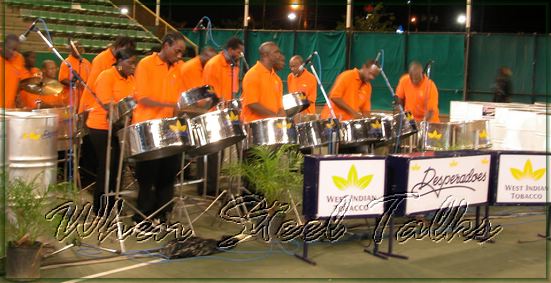
The Desperadoes
Steel Orchestra is based in Port-of-Spain, Trinidad and Tobago. Over
the last fifty years, the band has
established a record of achievement
unsurpassed by any other steelband.
Today the band continues to thrill
local and international audiences
with their special brand of music.
Desperadoes is at ease performing
in all genres from their scintillating
interpretations of the most complex
European classical music and Jazz
- to their melodious renditions of Soca, Reggae, Pop and Latin pieces. Desperadoes is recognized internationally
as the premier institution and symbol
of pure excellence in the world
of steelband entertainment. The
band has truly taken steelband music
to the next level.
With its musical
exploits, the band is a living legend
in Trinidad and Tobago and the wider
Caribbean. It has been victorious
in the Panorama competitions in
Trinidad and Tobago on ten occasions.
They were the Pan in the
21st Century
Champions in 2005 when they performed
Ordinary People and then
again
in 2006 with the selection
So Sick.
The band has also excelled at
the music festivals held in
Trinidad and Tobago having won
the Festival on three
consecutive occasions. As
acknowledgement of its musical
hegemony the band was presented
with
Trinidad & Tobago’s Chaconia Medal Gold National Award
and named the “Steelband of the
Century” by Pan Trinbago, the world
governing body for the Steelpan.
Beyond the domestic
arena, Desperadoes has toured
the Caribbean, Africa, the United Kingdom
and the United States of America,
Europe and Asia, performing at some
of the most prestigious cultural centres globally. These include
the Royal Albert Hall, Carnegie
Hall and the Apollo Theatre in New
York. The band also performed at
the World Olympics held in Atlanta,
U.S.A. Acknowledged globally as
one of the cultural icons of the
Caribbean, Desperadoes has also
appeared
with renowned international artists
such as tenor Luciano Parvarotti,
Jimmy Buffet and the Coral Reefer
Band with Robert Greenidge, and
Ralph Mac Donald of ‘Just the Two
of Us’ fame.
In 2007 the band
was an integral part of a Trade
and Cultural mission promoting Trinidad
and Tobago in the Far East – performing
in South Korea, Beijing, China and
India. In April 2009, at the Conference
of the Americas, Desperadoes
was among a select group of artistes
chosen to entertain the Heads of
Government of the Americas including
President Barack Obama of the USA.
Katzenjammers
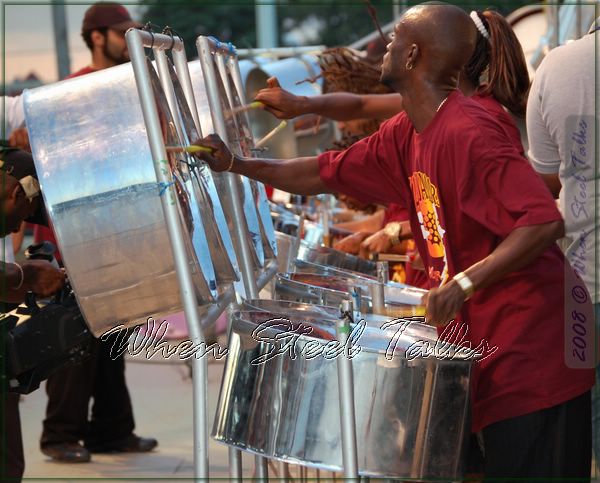 Katzenjammers
Katzenjammers Steel Orchestra
is the oldest playing steelband
on the island of Tobago. Formed
in 1951 in the fishing and tourism
village of Black Rock,
Katzenjammers is well known for its energetic
performance in the various
genres
of steelpan music; such as Calypso,
Pop, R&B, religious and Jazz.
The orchestra is the band of
choice in Tobago for government
functions, hotels, wedding receptions
and private parties.
To date, the orchestra has
enjoyed tremendous success since
its return to national competitions
in 2003. At present,
Katzenjammers
is the only orchestra in Tobago
to have won three National titles.
These are: National Tune of
Choice in 1963, and Pan in the 21st
Century in 2004 and
2008.
The organization prides itself
in discipline, dedication
and excellence, in order to
maintain its successes and objectives.
Steelpan music is one important
piece of community and soul
that has not been destroyed
despite neglect. It is therefore
not surprising that
Katzenjammers steel
orchestra is comprised mostly
of youths. These youngsters
play the steelpan, motivated
by the joy of the experience
itself. The great effort exerted
by the youth fuels a competitive
spirit amongst them and further
provides a platform to showcase
the plethora of talent and creativity
within the band.
Katzenjammers’ musical accomplishments
come from the soul of the arrangers,
players, traditional community
spirit and camaraderie which
have kept the band together for
over five decades. Veterans
such as Hugh Ramsey, Jeremy
Williams, Aldwyn Ramsey, Rupert
McCardy, Dwaine Archer, Handell
Alfred, Claude Ramsey and Brent
Charles have all contributed
to the successes of the band.
The orchestra is currently
managed by Beverley
Ramsey-Moore, captained by Jemma Duke,
directed by Maxon Ramsey
and has as its arranger Edwin Pouchet.
Musicians:
Tenors
Kersh Ramsey, Maxson Ramsey,
Kelesha Carter, Kenvern Marcelle,
Shevrolyn Jerry, Shumba George
Seconds
Kadion Moore, Claudius Agge,
Maurice Melville, Khadicia Julien,
Rimond Reid
Guitars
Teri Jack, Ricardo
Mc Pherson, Jenelle Moore, Kyrstal
Vincent
Cello
& Triple Guitar
Kasem Quamina, Glenroy Archer
Bass
Keeron Baynes, Kenneth Williams,
Shaquille Arnold, Shirlon Moore
Tenor
Bass
Sherry Arnold,
Shanice Arnold
Rhythm
Allan Duke, Sheralyn Jordan,
Hugh Ramsey, Glenford James,
Kelvin James
Invaders
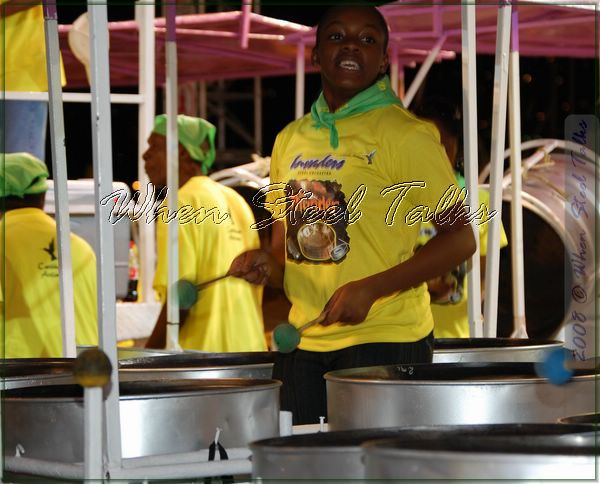 Invaders
In 1937, the breadfruit tree
at the Mannette family home
on Tragarete Road facing the
Queen’s Park Oval sporting grounds,
was the meeting place for an
unusual group of musicians. Stanley Hunte and Ellie Mannette
were the leaders of the youngsters
who talked about their own band
of steel drums. Some may have
described the group as a ‘gang’
but the neighbourhood boys
were going to focus on
music and steelpan, an
instrument that was still
being shaped.
They decided to call themselves
“Oval Boys,” after their first
panyard located under the stands
of the Queen’s Park Oval. They
collected discarded paint cans,
biscuit tins and other empty
metal containers to be used
as instruments. The Oval Boys
changed their name to “Invaders”
after seeing the US war movie,
“Night Invaders.” Soon their
permanent home was under the
breadfruit tree at 147 Tragarete
Road, where the band resides
to this day. Through experimentation
with materials available on
the street, they started to
bridge the gap between the earlier,
rhythmic beat of the tamboo-bamboo,
and the harmonies that would
soon emanate form the steelpan.
Those were days of rivalry,
innovation and excitement. The
rivalry between bands of Laventille
and John John in East Port-of-Spain, and those in Woodbrook
and Western Trinidad, often
led to violent clashes. During
the 1940’s, Invaders was one
of the most feared steelbands
on the road. The sight of their
battle flag was enough to frighten
the faint-hearted. Lord Blakie’s
(Carlton Joseph) calypso, “Steelband
Clash,” documented a confrontation
between Invaders and Tokyo,
a band from East Dry River
in Port-of-Spain.
In those days,
Ellie Mannette
was the creative force behind
the band, designing and tuning
the pans for which he earned
the title “Father of the Modern
Steel Drum.” His job in an iron
foundry gave him a special feel
and skill for steel and other
metals. Mannette
experimented
with the 50-gallon oil drums
in place of biscuit tins. He
sank the playing surface downward
into a concave shape instead
of the convex shape used at
the time, then went on to create
six of the nine main instruments
in the steel drum family. He
also discovered, through trial
and error, the uniqueness of
the note blend on each pan;
and that the sweetness of the
music could be brought out with
sticks wrapped with rubber.
For the past 25 years Mannette
has been at the forefront of
the steelband movement in the
United States. He left Trinidad
and Tobago for New York city
in 1967. In the USA, he has travelled extensively, making
and promoting the steelpan.
As a result of his efforts,
successful Steelband programmes
can be found from New York to
Washington State and from the
Dakotas to Texas.
Mannette works with over
200 public school, university,
community and private bands.
He gives lectures and conducts
seminars on the construction,
tuning and history of the instrument.
His work has been on display
in museums all across the United
States. Currently he resides
in Morgantown, West Virginia,
where he is artist-in-residence
at the West Virginia University.
Invaders’ growth and change
was partly due to its Woodbrook
location where a local theatre
was established in 1949 with
Invaders as the resident steelband.
It may have been a factor in
the 1960s when Shell Oil Company
became one of the first steelband
sponsors. Shell later changed
its name to Trintoc and then
Petrotrin, retaining sponsorship
until 1998.
Invaders produced many fine
panists and tuners who add
to the musical legacy created
by the founders. The youngest
Mannette brother, Vernon “Birdie,”
was tuner and captain for 25
years, maintaining Invaders’
reputation for ‘sweet’ pan.
Ray Holman, the prolific composer
and arranger started with Invaders
when he was only 13 years old.
His work with pan jazz arrangements
gives him a unique position
in pan history.
Spawned from Alexander ragtime
Band and Oval Boys, Invaders
produced many other bands. Among
them were: Saigon, Green Eyes,
Gale Stars, Pat,
Phase II Pan
Groove, Third World, Tropitones,
Metronomes, Troubadors, Dixie
Stars, Sombreros, Starlift and
Girl Pat.
Musicians:
Tenors
Rudolph Williams,
Anthony Phillip, Richard Bentham,
Natalie Baptiste, Jamaal Gibbs,
Luke Walker Kerri-ann Hyndman-Borris
Double
Tenors
Jason Ho,
Khadija King, Nicholas Oliver
Double
Seconds
Gibson Mark,
Myles Paynter, Kayode Robinson,
Kareem Browne, Atiya O’Neil
Double
Guitars
Leidman Dore,
Elroy Baptiste, Crystal Benthum
Cellos
Desiree Myers, Josanne Arthur,
Chelsea Bailey
Tenor
Bass
Steve Mendoza,
Chantelle Carimbocas
Bass
Courtney Taylor,
Nigel Gonzales, Petra Moses,
Glenda Boney, Giselle French,
Keneisha Barclay
Rhythm
Timon Valentine, Claude Griffith,
Oswald Williams, James Inniss,
Bernard Gibbs, Frankie Thomas,
Joseph Michael Richard
Fonclaire
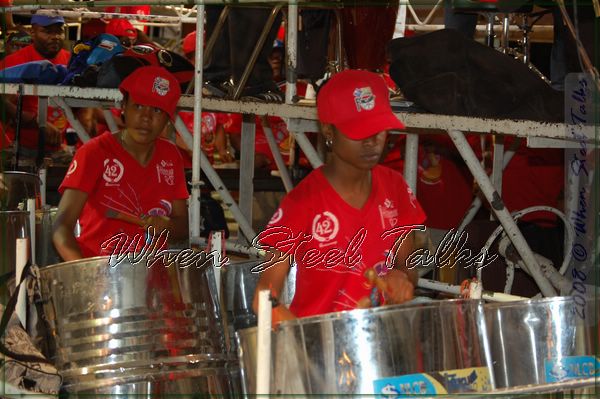 Fonclaire
NLCB Fonclaire is led by
Milton ‘Wire’ Austin, one of
the remaining founding members
of the band. Celebrating their
45th anniversary this year,
Wire recalls that the journey
of his band began in 1965. He
and a group of young people
living in and around the present
panyard pooled together their
innate ability to create melodious
sounds from inanimate objects,
like the oil drum, and formed
the steel orchestra. The band
derived its name from two adjoining
streets—Fonrose and Claire—in
the country’s second city of
San Fernando, where
the majority of the members
dwelled. In its early years
the band searched for a unique
sound and character to distinguish
itself from other pan sides.
In the four decades since
Fonclaire evolved, taking on
different appellations with
each new sponsor—Joseph Sabga
& Sons Ltd, NBC, Vat 19 and
now NLCB—the band systematically
tested its musical skill and
knowledge in its pursuit of
excellence. The breakthrough
came in 1971, the year of the
historic tie in the National
Panorama final between Solo
Harmonites and CIBC Starlift.
Fonclaire, playing a soulful
Rudin and Austin arrangement
of the Mighty Duke’s
Carnival
in Trinidad, placed fourth in
the competition. The band was
adjudged ‘People’s Choice’ and
led to Fonclaire securing the
distinguishing sound it craved,
becoming known as the band with
“the Soul Beat.” Pioneering
a mixture of vocals with steel,
accompanied by funk and soul
beats with a Caribbean flavour,
proved to be a winning combination
for this leading steelband.
Two successful LPs followed:
“Funk and Steel and Funk,”
and “Steel
and Brass,” with vocals by Elton
Xavier.
Always a contender for the
yet elusive National Panorama
title, Fonclaire has done the
City of San Fernando proud.
It placed second in 1975 with
a Lord Kitchener composition,
Spree Simon, and
again consecutively
in 1989, 1990 and 1991. Fonclaire
also placed third in 1986 with
another Kitchener made-for-pan
calypso,
Pan Here to Stay but
the band’s most memorable performance
to date, was its scintillating
rendition of Ken “Professor”
Philmore’s arrangement of
Pan
by Storm in 1990. Across the
globe, in North and South America,
Canada and the Caribbean, they
have won rave reviews with their
repertoire of seventy-two selections
in different styles such as
jazz, gospel, contemporary,
hot soca, sweet soca, vintage
kaiso, reggae, Cuban/Latin American,
pop and R&B. Fonclaire has also
had the distinction of performing
with internationally renowned
recording artiste Billy Ocean,
legendary jazz exponent Clive
Zanda and reggae band Aswad.
The steelband has also aligned
itself with several international
recording agents and consultants
as it continues to revolutionise
the sound and image of the instrument.
Musicians:
Tenors
Joseph Reid, Henriques
Lakatoo, Talmai Layne, Akini
Pompey, Geary Hinds, Donyell
Thorne, Teri Simone Henry, Carliza
Remy, Atherley Figaro, Marc
Sebeeran
Double
Tenors
Philip Maurice,
Adana Pompey
Double
Seconds
Kale Weekes,
Shennel Paul, Alyssa Fredericks
Double
Guitar
Cherisse Remy,
Marlon Gaymes
Cello
Joyanne Farrell, Rachelle
Regis Glaud, Cliff Murphy, Aretha
Austin, Haille Stewart
Bass
Teriq McGillivery, Aaron
Williams, Kealon Clarke, Elon
Chatterpaul, Hayden Marchan,
Frederick Chatterpaul
Drummer
Kervin Philbert
Percussion
Brandon Greenidge
Rhythm
Alvin Pierre, Marlon Williams,
Keron Sylvester, Dean Constance
Congas
Deryk Ayum
Exodus
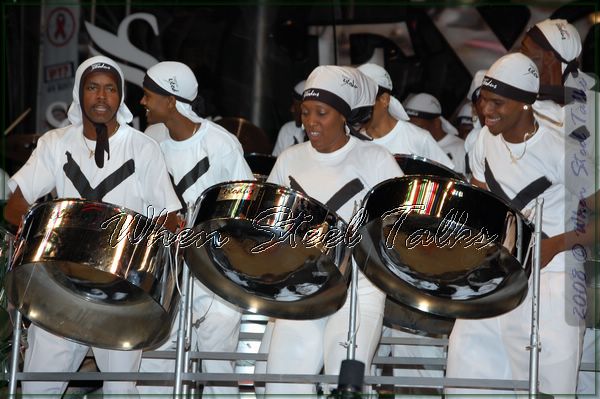 Exodus
Exodus was formed in May
1981 and ventured into the National
Panorama competition in 1982,
a mere nine months after its
formation. The band placed
eighth
in the finals. Since then Sagicor
Exodus has established itself
as one the premier steelbands
in the world. History will show
that over the years, Exodus
has won - at one time or
another - almost all major steelpan
competitions in Trinidad & Tobago.
Among its achievements are:
National Panorama finals
on four occasions; National
Steelband Music Festival on
three occasions; World Steelband
Music Festival in 2002 and
2005; Caribbean Panorama on the
single occasion it was held
and;
Steelband Champion Of Champions
which commemorated 40 Years
of Panorama. Exodus is in fact
the
reigning World Steelband
Music Festival Champions which
they won at Madison Square
Garden, New
York
in 2005. Internationally, Exodus
has toured several major cities
worldwide and has produced six
compact discs. Sagicor Exodus
is also the holder of Trinidad
& Tobago’s second highest medal
of honour, The Chaconia Gold.
Musicians:
Tenors
Kurt Edwards, Jamaal Lewis,
Christopher Morris, Lisa Mc
Clutchie, Michael Beharrysingh,
Simone Small, Kevin Lewis
Double
Tenors
Shannon Balbosa,
Alyshia Wiseman, Ronald Clarke
Double
Seconds
Stephen Pierre,
Anthony Rose, Stefon Pierre,
Roisha Edwards, Brigid Haynes
Cellos
Julie Williams, Hayden Hosein,
Roland James, Gregory Mansano,
Kizzy Lewis
Tenor
Basses
Clement Springer,
Jeanelle Armour, David Dolabaille
Double
Guitars
Shivon Bourne,
Frederica Venus-Bourne, Afiya
Farrel
Low
Basses
Jason Aberdeen,
Andy Husband, Quacy Ward, Shane
Nelson
Percussion
Kail Thomas, Keith Gardiner,
Gabriel Fonrose, Errol Wickham,
Dunstan Thomas, Don Wilson.
Keyboards
Pelham Goddard
Trinidad
All Stars Steel Orchestra
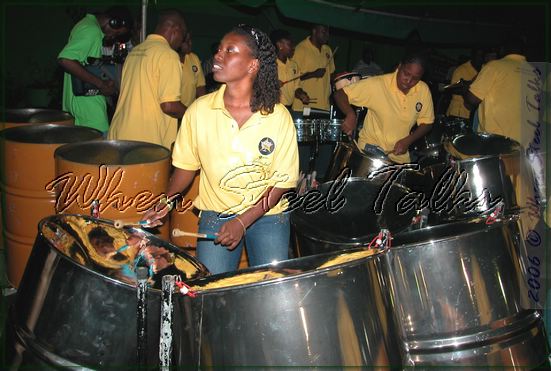 Trinidad All Stars
The rich and colourful history
of the steelband movement in
Trinidad and Tobago is interwoven
with the Neal & Massy Trinidad
All Stars. Developed between
the first and second World Wars,
the steelband was born of an
innate and explosive
creativity. The
band’s roots go deep and its
turbulent early beginnings and
explosive creativity are the
hallmarks of steelband music
today.
“Hell Yard Boys” was the
name they gave themselves back
in 1935. Hell Yard was a poor
area on the banks of the East Dry River in Port-of-Spain. The movement away from “tamboo-bamboo”
to pan had only just begun.
This name changed several times
– to “Second Fiddle,” then to
“Cross of Lorraine,” and finally
“All Stars,” chosen because
of the perceived superior ability
of the players. Soon after the
war, “Trinidad” was added.
In 1982 the contributions
of Trinidad All Stars to the
steelband movement were recognised
by the Government of Trinidad
& Tobago with the presentation
of a national award – the Humming
Bird Medal (Gold). Four years
later, the band was again honoured
with an award from the Port-of-Spain City Council.
One of the many achievements
of the band was its pioneering
of classical music on the road,
played to the rhythm of calypso
- affectionately known as
the ‘Bomb tune.’ This highlighted the capacity
of the steelpan to go beyond
the previously self-imposed
musical bounds of calypso or
boleros. Trinidad All Stars
was the first band to play the
pan with two sticks. For the
first time, both the melody
and the harmony could be heard
played together. The band made
the first “Quatro Pans” later
called the ‘Grundig’ and the guitar
pans. A former captain of Trinidad
All Stars,
Neville Jules, also
had the privilege of making
the first bass pan.
These accomplished musicians
have maintained a standard of
excellence through their innovative
mastery of the instruments.
They have secured first place
victories in the biennial Music
Festival on six occasions, have
won the National Panorama six
times, the Bomb Competition
on countless occasions and successfully
held nine Classical Jewels concerts.
The members of N & M Trinidad
All Stars Steel Orchestra have
carried the vibrant culture
of Trinidad & Tobago around
the world: Australia, Barbados,
Bermuda, Canada, China, France,
Ghana, Guyana, India, Jamaica,
Nigeria, Puerto Rico, Scotland,
Spain, St. Maarten, the United
Kingdom and the
United States.
Musicians:
Tenors
Brenton Peltier, Onika Baird,
Kelvin Harris, Janeil McClean, Ria Toppin, Nikisha Patrick,
Cassie Figaro, Netsa Nathan
Double
Tenor
Natasha Lyndsay
Double
Seconds
Shaoubaca
Elie, Verdell Hearwood, Cleve
Leonard, Joseph Long
Triple
Guitars
Marlon Howe,
Denise Hernandez, Shareen Walcott
Four Cellos
Petal Joseph, Monica
Roach
Basses
Leon Long, ren Hamlet, Denise
Riley, Nicole Belgrave, Donna
Da Costa
Percussion
Jason Lewis, Michael Mohammed,
Anthony John, Lennox Ambrose,
Errol Collins, Trevor Garraway,
Junior Telemaque, Carlton John
La Horquetta
Pan Groove
La Horquetta Pan Groove is
an unsponsored Single Pan Steel
Orchestra, also known as LH
Pan Groove. The band was formed
on 9th December 1989,
and
mainly consists of youths from
the community. The band assists
themselves by means of fund-raisers
and play-outs. They
are at this
time in the transformation process
from Single Pan to Medium Conventional
Band Category for Panorama 2011.
This band has excelled in
major national competitions.
They have been awarded 1st place
in the National Panorama Competition
for five consecutive years,
as well as the TSTT
(Telecommunication Services
of Trinidad & Tobago) Pan Down
Memory Lane Competition four
years in a row.
They are currently managed
by Kirt Robinson and captained
by Michael Prudhomme.
Musicians:
Tenors
Christine Ferdinand, Russell
Edwards, Georgella Scott, Kelley-Ann
Bruce
Seconds
Che Carter, Michael
Prudhomme, Nadia James Guitar
Kyle Toppin, Kerry Carter, Kum
Thas
Rhythm Section
Roger
Robinson (Dudup), Ross Thomas
(Slam Bass), Leason Jacobs (Kettle
Drum), Chadwich Cumberbatch
(Marac), Rodney Augustus (Iron),
Dextan Lewis (Toc Toc), Chad
Roberts (Scratcher)
Phase II
Pan Groove
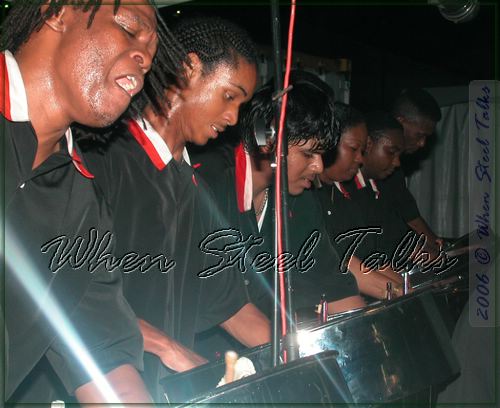 Phase II Pan Groove
Phase II Pan Groove was formed
in 1972 by a small group of
innovative musicians seeking
to produce a more creative sound
on pan, by experimenting not
only with different types of
music, but also with the combined
effects of contemporary instruments
and pan.
Undoubtedly, the most outstanding
feature about Phase II Pan Groove
is the fact that from its inception,
the bold decision was taken
to promote the performing of
original compositions in Steelband
competitions earlier pioneered
by
Ray Holman. In keeping with
this policy, the band consistently
elected to perform pieces specifically
composed and arranged for the
instrument, by its charismatic
leader and Musical Director
Len ‘Boogsie’ Sharpe.
Despite this calculated disadvantage,
Phase II, after an initial period
of non-acceptance, was able
to gain some recognition from 1977, when the band captured
its first North Zonal title,
and thereafter emerged as Champions
of the North for a then unprecedented
four consecutive years (1986-1989),
eventually creating history
in 1987 by becoming the first unsponsored band to win the
national Panorama competition,
as well as the first band to
do so performing its own tune.
This feat was repeated in 1988,
and from that year, the band
has very rarely placed lower
than in the top three positions,
including its most recent national
titles in
2005,
2006 and
2008.
At the Steelband Musical
Festival, ‘Boogsie’ has been
dubbed the Mozart of Pan by
foreign adjudicators, as his
compositions have been able
to stand alongside those of
the great classical masters.
This was evident at the Festival
of 1986, when the band captured
third place, performing ‘Dance
of the Douens’ composed by ‘Boogsie.’
Over the years Phase II has
toured extensively throughout
North America, the Caribbean,
Europe, South Africa and Japan,
and had the distinction of being
part of the cultural contingent
that accompanied our Soca Warriors
to the 2006 World Cup in Germany.
Its virtuoso musical director,
generally regarded as the world’s
premier panist, along with
his acknowledged genius as a
composer and arranger, has toured
extensively around the world
as a solo artiste, sharing stages
with some of the world’s greatest
jazz musicians. He has recently
been inducted as an honorary
distinguished fellow of the
University of Trinidad and Tobago
where he now teaches musical
improvisation. Mr. Sharpe was
also awarded the Chaconia Silver
Medal in 1988 and the Hummingbird
Medal Gold at the 2009 awards
ceremony, for his contribution
to the art form.
Musicians:
Tenors
Ronald Ashton, Franklyn
Olliverra, Joseph Pollidore,
Rondell Williams, Gary Padmore,
Hapty Prince, Roland Lyons,
Mervyn Caines, Ronald Mohammed
Double
Tenors
Patrick O’Brien,
Wendell Bleasdell
Double Seconds
Len “Boogsie” Sharpe, Amanda Gooptar,
Terry Bernard
Double Guitars
Errol Skerritt, Steve Taylor,
Ronnie Collins, Anthony Franklyn
Four
Pan Cellos
Ashika
Gaspard, Kenneth Harewood
Tenor
Bass
Judy Noel
Seven Bass
Bennie Matthews, Jenessa
Baptiste, Michelle Clarke
Nine
Bass
Carlisle Sobers
Percussion
Ronnie Howard, Dennis
Urquhart, William Fraser, Michael
Spencer, Kevin Herbert, Clayton
Morris
Sound
Specialists of Laventille
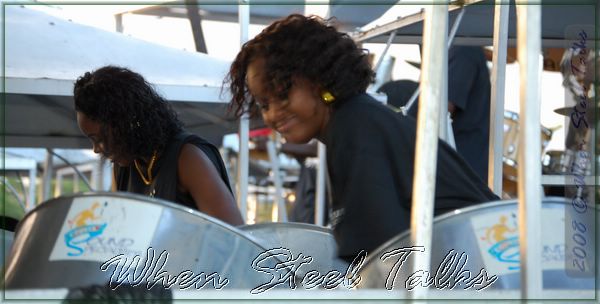 Sound Specialists of Laventille
Laventille has produced many
a top steelband. They include
Desperadoes, Highlanders, Savoys
and in 1975 Sound Specialists
from the Eastern Quarry area.
The nearby Tokyo was the band
to which Sound Specialists owes
its birth, since many of the
original players in Sound Specialists
which started out as a traditional
band, came from Tokyo.
In the competitive arena,
Sound Specialists’ first incursion
was in 1976 when the band took
part in the annual Guardian
Newspapers contest. This competition
was held however not at the
St. Vincent Street Car Park
as at present, but at the grounds
of the West Indian Tobacco
company in Champ Fleurs,
east Trinidad. The tune selected
was Flag Woman by Kitchener
and this was the Road March
of the year.
The band gained sponsorship
from Readymix Limited in 1977
and as Pan Trinbago started
a competition for “Pan around-de-neck” bands
they played
Jump Judges Jump
by Shadow. The band, now improving
by leaps and bounds, qualified
for the semi-finals. By 1980
the band had improved to such
an extent that they placed
fourth in the finals for
single pan bands in Panorama. The
days of being a ‘traditional
band’ were numbered - so that when
“Pan is Beautiful Too” came
about in 1980 the band had been
converted into a conventional
one. In 1983 Sound Specialists
lost its sponsor Readymix due
to financial constraints and
did not participate in the subsequent
two Pan is Beautiful series
in 1984 and 1986. By 1988 the
band reappeared. There was no
Music Festival in 1990 due to
the attempted Coup in July of
that year. However, in December
1990 for the first time a competition
was held entitled Pan Parang.
It was held in the Arima Velodrome. Sound Specialists won the contest
in the category for Conventional
Band. The band played
A Trini
Christmas and emerged with
702 points.
In 1992 Courts Furnishings
(Trinidad) Limited sponsored
the band. The band pleased their
new sponsors by reaching the
finals of that year’s festival
with a performance of Gustav Holst’s
Jupiter and Superblue’s
Get
Something and Wave. The band
has made every music festival
finals since, so when Pan Trinbago
stated the Trinidad and Tobago
leg of the World Steelband Music
Festival, Courts Laventille
Sound Specialists was confident
that they would have qualified,
and after performing John Williams’
Throne Room
and
End Titles
and Len “Boogsie” Sharpe’s
Clear
De Way, the band placed sixth.
A re-branding of the band
took place in 2004 and they
are now known as the Courts
Sound Specialists of Laventille.
This orchestra continues to
thrill many with their music
and has been outstanding with
their J’Ouvert Bomb presentations
and at the Laventille Steelband
Festival. The year 2004 saw
them placing fifth in the Medium
category of the National Panorama
finals. In 2004 they qualified
as one of Trinidad and Tobago’s
representatives to the finals
of the World Steelband Music
Festival.
The band was a semi–finalist
at the 2005 National Panorama
competition and was the winner
of the J’Ouvert Bomb Competition
in the classical category. At
the 2005 TSTT Pan in the
21st Century Competition they
placed third with a breath taking
rendition of
Morning Dance.
And the orchestra also won
the ‘Spirit
of Emancipation’ award
in the sixth annual
Laventille Steelband
Festival Street Parade.
Also in June of that year, Sound
Specialists of Laventille placed
fourth in the
World Steelband Music
Festival at Madison Square Garden,
Manhattan, New York, USA.
2006 – A time of growth for
Sound Specialists of Laventille
where the finals of the National
Panorama saw the band place
second in the Medium category.
This showed that Courts Sound
Specialists of Laventille was
taking on the mantle of being
a great Laventille Steel Orchestra.
2007 &
2008 the band won
the National Panorama competition
in the Medium category playing
Colleen Ella’s
Johnny and
Destra Garcia’s
Hooked respectively.
In 2009 the band placed
third
in the Panorama competition
and sixth in Pan
in the 21st Century competition.
In 2010 the band placed second in
the Panorama competition and
sixth in the B mobile Pan in the
21st Century competition.
The band has gone from strength
to strength and by its enthusiasm
and commitment will, in the near
future, accomplish its ultimate
aim to win the National and
World Steelband Music Festival
titles as well be one of the
best Steel Orchestras in the
world.
Musicians:
Tenors
Stephen Thomas, Ryan Pran,
Sheleen Baynes, Jason Mc Kell,
Ja’vaughn Ramsay, Kevin
Williams, Sydney
Christopher
Double
Seconds
Wendell Joseph,
Toni Williams, Stephanie London
Guitars
Ayoka Hicks, Akeel Baines,
Willis Roben
Cellos
Cordell Melville, Okerah
Parris, Elizabeth Bartholomew,
Rholda John
Bass
Narissa Charles, Dary Ann
Cordner, Nikita Charles , Cindy
Campbell, Andre Lamy
Rhythm
Wayne Scipio (captain),
George Cruickshank, Daniel Phillip,
Mervyn Mc Kell, Ronald Mc Clean,
Merlene Ramsay, Willbun Crichlow,
Henson Neptune
Renegades
Steel Orchestra
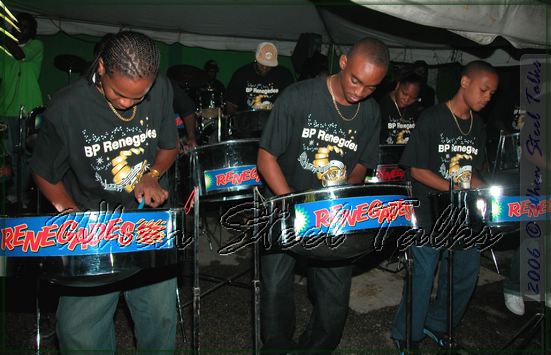 Renegades
The BP Renegades Steel Orchestra
is one of the oldest surviving
steel bands in the world today.
Launched on May 24, 1948 (Empire
Day), they took their name from
a Western movie. In the early
years, Renegades was not a major
musical force and due to its
notoriety of being one of the
toughest street bands in the
city, suffered for recruits.
They however transformed their
image to become by the 1980s,
one of the leading steel orchestras
in the world.
Renegades dominated the National
Panorama Competition in the
80s and 90s, with nine victories
from 1982 to 1997. It was the
first band to play in position
one at the finals (1982) and
win. The band was also in the
top three spots fifteen times,
from 1980 to 1997; it is the
only band to have won Panorama
titles back to back on three
separate occasions, (1984-1985;
1989-1990; 1995-1996), and to
have garnered a hat trick (in
1995, 1996 and 1997). In fact,
when Renegades won in 1997, it
was also the first band to have
won as many as nine Panorama
titles.
Renegades has placed second
on three of the five occasions
it participated in the biannual
National Steelband Music Festival,
Pan is Beautiful and in 2008
swept the field in the minor
categories winning the soloist,
duets and quartet categories.
Renegades also won the Pan in
the 21st Century Competition
in 2003, with Joey Lewis’
Pint
of Wine, placed second in 2006
with Lionel Richie’s
All Night
Long and took second
place again in 2010
with Celine Dion’s
I Surrender.
Renegades is also the most
travelled steel orchestra in
the world. They have toured
every continent bar one-
Antarctica.
In 1990, they were the featured
act at Paris Bastille Day with
French pop composer and multi-media
performer, Jean-Michel Jarre
before an estimated world record
audience of over two million
people. That same year they
opened the Nelson Mandela Welcome
Rally at the Yankee Stadium,
in New York City. In 2006, Renegades
performed at the 18th Commonwealth
Games in Sydney and at the WOMAD
Festival in Adelaide, Australia.
On August 29th, 2009, the band
performed at the John F. Kennedy
Centre for the Performing Arts
in Washington DC, to commemorate
the 47th anniversary of the
independence of Trinidad and
Tobago; the orchestra first accompanied
dramatic soprano Anne Fridal,
soprano Renee Solomon and lyric
baritone Marvin Smith, before
filling its own time slot with
a variety of musical pieces.
Renegades is the recipient
of many awards, including Trinidad
and Tobago’s second highest
award, the Chaconia Gold Medal
(1992) for its outstanding contribution
to the culture of Trinidad and
Tobago. In 1986, the band received
the Keys to the City of Port-of-Spain and in 1990, a Pan
Trinbago Award for its outstanding
contribution to the development
of the steel band movement.
Renegades is also a five-time
Sunshine Award recipient.
Musicians:
Tenors
Levi Etienne, Kershiff Perry,
Kain Cox, Marvis Mohammed, Micahi
Felician, Wayneisha Wilson
Double
Tenor
Cleveland King,
Anthony Lewis, Dexter Bernard
Double
Second
Ishmael Wharton,
Candice Andrews
Double
Guitar
Jessica Bentick
Three
Cellos
Stacy Doughlin,
Anthony Crichlow, Akelia James
Four
Cellos
Aaron Franklin
Tenor
Bass
Kayesha Ollivierre,
Ayesha Moses, Rudolph Grant,
Joel Allick, Christian Benton
Percussion
Andrew Brumant, Vance Romain,
Juma Simmons, Kaaron Romain,
Negus Granger, Gabriel Phillip
Skiffle
Bunch Steel Orchestra
 Skiffle Bunch
Founded in 1976 by a closely
knit group of young people in
Vistabella, South Trinidad,
these globe-trotting ambassadors
chalked up seven Panorama victories
and were runners-up on three
occasions. In between, there
were other accolades like Caribbean
Festival Winner (1977) and Best
Beating Steelband in the Prime
Minister’s Best Village Competition
(1976-1983).
The Skiffle Bunch Steel Orchestra
has been the leader among Ensemble
groups in Trinidad and Tobago,
however they have since 1993,
donned Conventional Orchestra
Status and have challenged the
very best in that category.
Their tenacity together with
their commitment to the development
and marketing of the steelpan,
has made them a clear leader.
In the short period since that
time, the band has chalked up
first place in the South/Central
Region Panorama Competition
1996, 1997 and has placed
sixth
at the national Finals in 1995
and fifth in 1997. They placed
fourth in the 1995 National
Pan Chutney competition and
second in 1996, as well as winning
the Best Dress and Best Oriental
Percussion categories. TCL Group
Skiffle Bunch won the southern
leg of the 1998 Steelband Festival,
placed third in the National
Final for Orchestras and was
the overall winner of the first
World Steelband Festival held
in October 2000. In 2009
Skiffle Bunch did Trinidad’s
southern region proud when
they took home the
championship title for Pan
in the 21st
Century. The band has
produced three albums of their
work and is a recipient of many
national and international awards.
Musicians:
Tenor
Chloe Perrott, Cherelle
Greaves, Wanessa Charles, Rheanne
Edwards, Carlos Ayers, Anella
Seecharan, Sean Villaroel, Joshua
Regrello, Asem Jones, Leon Harewood,
Renee Tuitt
Double
Tenor
Ayanna Reyes,
Aaliyah Reyes, Cedel Hinds,
Sherise Regis-Mc Farlane
Double
Second
Theron Thompson,
Ariel Graham, Shaquille Forbes
Double
Guitar
Lesley Ann
Samuel, Kami Marie Marcelline,
Nicola Joseph
Three Cello
Keina
Calliste, Kyra Huntley
Tenor
Bass
Wendel Charles
Seven
Bass
Brandon Babb,
Trudy Murray, Afiya Williams,
Charisse Syms
Percussion
Charles Webb, Hudson Henry,
Floyd Ravello, Andrew Reyes,
Peter Fyfield
Silver
Stars Steel Orchestra
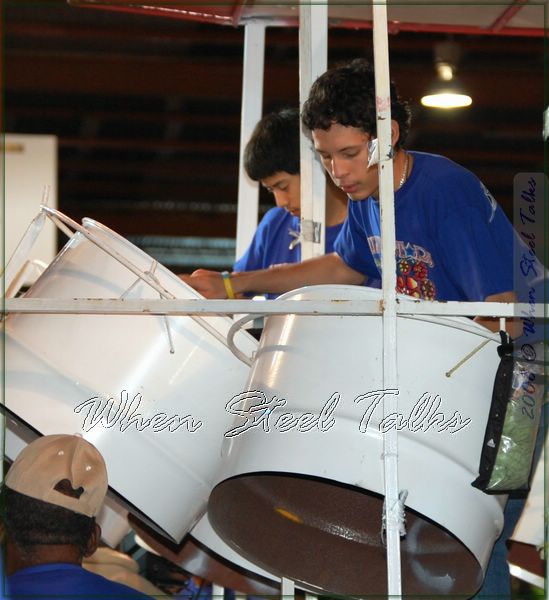 Silver
Stars
Silver
Stars
The Newtown Steel Orchestra
was founded in the mid-late
1940’s by Ramon and Roy Young.
The band members comprised of
fellow St. Mary’s College students
and Queen’s Royal College
students. In
1950 the band’s name was changed
to Valentino’s and again in
1952 to Silver Stars Steel Orchestra.
Even in these early days of
existence, Silver Stars was
always a trendsetter.
In 1952, on an ill-fated
night, seven band members were
arrested for disturbing the
peace by playing pan and were
taken to jail. This had a traumatizing
effect on the players, their
families, neighbours and the
pan fraternity as a whole. In
those days, pan was considered
a nuisance and anyone playing
pan was not held in high esteem
so band members hid to practice.
When the young men appeared
in Court, the Magistrate ruled
that pan would not be a nuisance
until after 10.00 p.m.; he also
awarded the young men $250.00
each in compensation for their
ordeal. This triumph marked
another first for the band and
led to the legalisation of steelpan
playing until 10:00 p.m. Other accomplishments
include being the first steelband
to compose their own tune for
Music Festival -
Russian Meringue
in 1950 and
On a Creole Melody
in 1966; and in 1963, being the
first steel orchestra to win
the prestigious Carnival title
“Band of the Year” with the
portrayal of Gulliver’s Travels.
Silver Stars temporarily
closed its doors in Trinidad
in 1974, when the captain and
arranger Edgar ‘Junior’ Pouchet
accepted a contract with Disney
World, Orlando, Florida, USA
(1971-2000). In 1986 Silver
Stars re-opened in Trinidad
with Edwin Pouchet as the captain
and arranger. The band continued
to perform for private functions,
maintaining their “best dance
band” in the country status
with quite a varied repertoire
and also competing at Carnival
competitions with great success;
the most notable is the Berger
‘Last Lap’ competition which the
orchestra won for three consecutive
years, among other titles.
In 1991, Parang and Steel
was launched. Edwin conceived
the idea based on his familial
background. His own family was
involved in pan and his uncle
Alfred Codallo was very involved
with Parang, so, he thought
that a marriage of the two arts
would be innovative, and supporters
of both art forms would not
have to travel outside of the
city limits for quality entertainment.
Parang and Steel has grown and
developed over the years and
has become a popular function
over the Christmas season. The
six consecutive Saturday nights
of entertainment are enjoyed
by hundreds of appreciative
patrons each night. This event
is also listed in the Tourism
Development’s diary of Events.
In 1999 Edwin took the decision
to return to the Panorama arena
and national competition circuit
after an absence of approximately
twenty-three (23) years. Since
that year, Silver Stars has
achieved some of the highest
awards by any steel
orchestra, but
in the shortest period of time,
especially from a band making
a return.
In
2009 the Silver Stars
was awarded the
first prize
in the large band category National
Panorama competition with
First
in de Line composed by captain
Edwin Pouchet. This feat was
repeated in 2010 with the song
Battle Zone, again composed
by Pouchet. Along with national
acclaim, this steel orchestra
has enjoyed accolades from international
audiences, having performed at
various festivals in North America.
Musicians:
Leader/Arranger
Edwin Pouchet
Tenors
Oswin Williams (Choreographer),
Jelani Cielto, Jason Harewood,
Mark Jones, Timothy Tilokee,
Solange Baptiste, Cathy-Ann
Francis, Carol Andrews, Jovan
St. Vincent
Double
Seconds
Shannon Mc
David, Vincent Mitchell, Franklyn
Garcia, Danielle Castillo
Cellos/Guitars
Junior Goolcharan, Lisa
Goolcharan, Gregory Emmanuel,
Anika Charles, Brenda Crosby
Bass
John Lopez, Larry Lai, Deborah
Charles, Elizabeth Antoine,
Lauren Pierre
Rhythm
Christopher Mohammed, Donell
Thomas (Conductor), Selwyn Francis,
Carlan Harewood, Austin Lee,
Winston Quashie, Kirl Stanislaus,
Balogun Olatunji