


Astor Johnson: “I see the pan music as any other form. I have worked with a little with Earl Rodney and some of “Boogsie” Sharpe′s music as well - I find them very progressive - very lending towards dance movements, I think mostly because of the way they take a melody and then they would do a lot of counter structures and phrases within the melody - the same way one choreographs.. ...However what I would like to see done is a little more on the educational side - this is why I think your program dealing with the evolution of pan is so important. The majority of the younger choreographers and dancers are strangely enough not very knowledgeable about how pan came about at all.
Exclusive interview with Von Martin
“You would be surprised to know that if you ask them, they simply do not know.. Interestingly enough, I am involved in a project now... to get a possible television program that we want to do in dance depicting how this whole thing started, the pan movement, the era has probably arrived when we are going to get into this kind of exercise. Really educating the public as to the evolution of pan. ...You find that today there is a lot of lack-luster interest in the pan - probably for Carnival, yes -- outside of Carnival, no. I am very obsessed with the idea that the reason for this is a non-knowledge - no information really about what the pan is about - an awareness about where it came from, how important it is to us, what a great contribution it is by Trinidad & Tobago. You know the old story when you live by the sea you take it for granted everyday... ...the same way with us; we have something, the steelband, here, that is so vital and yet taken for granted.”
Point Fortin, Trinidad:
“...Johnson danced as a youth with the Burey Thomas and the Julia Edwards dance companies before leaving Trinidad in the mid-1960s to pursue a degree in Education at Howard University. He continued to perform while at Howard and made numerous appearances with The Trinidad Steelband of Washington, DC, dancing the “flaming limbo” and other popular Trinidad dances.
“While in the USA, he received training at various Black Dance institutions, such as the Erika Thimey Dance Theatre, the Harlem Dance Theatre, and the Maida Withers and Paul Sansardo School of New York. He returned to Trinidad in 1970, formed his own dance group, The Astor Johnson Repertory Dance Theatre of Trinidad and Tobago, and choreographed his own shows.
“In 1989, his legacy was established when his dance group was awarded a Trinidad & Tobago Humming Bird Medal Gold for its contribution to the culture. In a tribute to its founder, artistic director, and resident choreographer, The Astor Johnson Repertory Dance Theatre staged the show “Astor” at Queen′s Hall on September 14, 2003.. ....” -- Ronald C. Emrit - panist and Trinidad & Tobago Cultural Historian
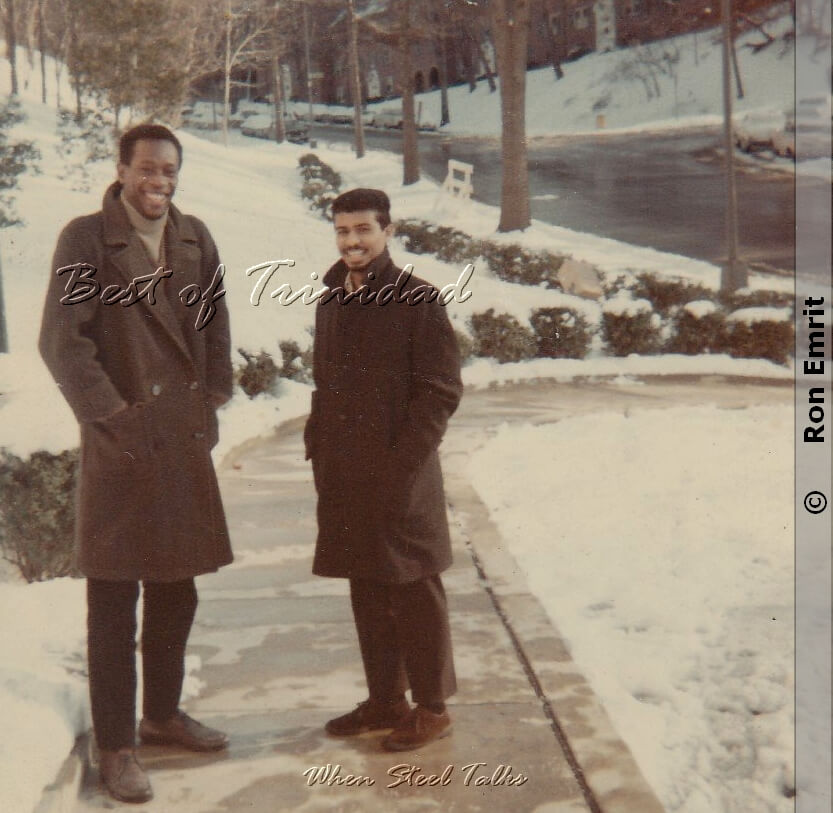
Astor Johnson and Ronald C. Emrit - A Break from Classes at Howard
University, Washington, DC (1966) - image copyright Ronald Emrit
Noted and respected veteran journalist and steelpan documentarian Von Martin, through his series of exclusive interviews with key figures in the history of the development of the steelpan instrument - provides us with an opportunity to hear the thoughts and memories of these notables up-close and in their own voices. And one such, Astor Johnson, has been featured here.
*** Interview audio provided by and published with the expressed permission of, Mr. Von Martin.

Astor Johnson
 Ceremony of the Drum Choreography by Astor Johnson
Leave a comment in the WST forum