
 A
Dream Coming True… Pan in the Schools of Trinidad and Tobago!
A
Dream Coming True… Pan in the Schools of Trinidad and Tobago!
More members of PSCC: From left: Nestor Sullivan, Ron Perryman, Pat Adams, Andre Moses.
Trinidad and Tobago - From as early as 1956, steelband teacher and arranger, Nervin Saunders, had already established a steelband in the R.C. Primary school in the village of Blanchiseusse. In the late sixties, Scofield Pilgrim introduced the Steelpan to the prestigious QRC Magnum band. By 1970, Ray Holman had followed his mentor and brought pan to another of the top schools in Trinidad, Fatima College. By the 80s a number of persons and institutions played leading roles in the continuing establishment of ‘pan in the schools’. Here we are in the 21st century and still waiting for it to happen in a ‘real’ way.
It was at the Pan Trinbago Convention of 1980 that the first official call to put pan on the School Curriculum was made. Two of the nation’s well-known music teachers, Ms. Joyce Clement and Ms. Louise McIntosh made an impassioned plea for Pan Trinbago to intervene in the Pan in Schools initiative. They felt that, even though there were some schools that had been innovative enough to include steelpan in their music departments, there were still many music teachers who felt they were not adequately trained and so lacked the confidence to teach music via this instrument. At the same time, the use of the steelpan as an integral part of music was becoming more entrenched in England and North America! Out of this historic intervention came a resolution to appoint a sub-committee to address the issue of Pan in Schools in Trinidad and Tobago and to develop strategy to ensure its widespread success..
The committee was formed in 1981 under the Chairmanship of Mr. Andre Moses, then-Treasurer of Pan Trinbago, along with Ms. Alma Pierre of the Ministry of Education, and Mr. Jerry Jemmott and Mr. Selwyn Taradath, both seasoned and successful steelband persona. The Moses Committee plunged straight into action by organizing the first of ten (to date) biennial Schools’ Steelband Music Festivals. This served to fuel the interest and competitive spirit among the schools and provide a platform to showcase the plethora of talent and creativity in the nation’s schools. Along with this was a Pan Tuners Convention at which the tuners approved a range of instruments (including note placement) for the schools, as well as a survey of schools to ascertain which schools were desirous of establishing their own steelbands.
In 1987, the Ministry of Education made its first major move to assist with the Pan in Schools initiative as pioneered by the Moses Committee. After several stops and starts, it was in 1991 that twelve schools were selected by the Ministry for a pilot project which included the provision of pans and full-time tutors following a set music programme. By the end of the 90s the Pan in Schools movement could boast of almost one hundred school steelbands. This initiative was already drawing the interest of other prominent persons in the local music/pan world. Among them were Pat Bishop, Desmond Waithe, Dr. Dawn Batson, Fazal Mohammed, Ian Belgrave, Barbara Lowhar and Lydia Jackson. Along with this, two other inspired developments had begun – the inclusion of the Steelpan as a musical instrument of choice on the CXC Music Syllabus, and the establishment at the then-Creative Arts Centre of UWI St. Augustine, of a Certificate Programme in the use of the steelpan in teaching the music syllabus.
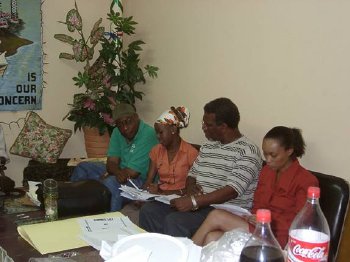
Some members of the PSCC in deep discussion; from left: Ian Teddy Belgrave, Nubia Williams, Gofrey Joseph, Amanda De Silva.
Collectively, all these developments served to successfully create a school steelband movement of growing sophistication. Among the ‘graduates’ of the Pan in Schools programmes are Liam Teague who has graduated from the University of Illinois, Chantal Esdelle from Berklee College of Music and Sean Thomas from Thelonious Monk Institute of Jazz. Now the cry is for structure and a well-defined policy for Pan in Schools! To serve this call, the new Pan in Schools Co-ordinating Council (PSCC) was established in June 1999. This body has been given the mandate by Pan Trinbago and the Ministry of Education to proceed with the implementation of a structured programme for the curriculum and development of Pan in Schools. The proposal is to provide an interdisciplinary steelband curricula which would seek to prepare the student to play a leading role in the burgeoning steelband industry in this the era of the internationalization of the steelband.
The PSCC has taken up this challenge with characteristic gusto and has organized several conferences for Music teachers across Trinidad and Tobago, from October 2000 to date. The first such conference was attended by ninety-nine (99) primary school music teachers and thirty-three (33) secondary school teachers as well as members of the pan fraternity who were involved in school music programmes. The pilot project proposed is to introduce pan on the curriculum of at least one hundred (100) schools by September 2003! The PSCC is also working along with the Ministry to establish the proper infrastructure in the schools to ensure that the programme is a success. At the same time, PSCC is involving Pan Tuners and other persons involved in developing a steelband to heighten the awareness of their role in the future of the pan industry and the legacy they must share with the youth to ensure that our indigenous music remains alive. A Pan Tuning Workshop for music teachers and students was held at the end of April 2003. Meanwhile, preparations are under way for the 11th Biennial School Steelbands Festival in October 2003, starting with a competition for a Test Piece composition. The theme of this year’s festival is “A Heritage of Folk Music”.
Good luck to the PSCC!! Let’s give our children what they deserve… pride in our national instrument… the instrument of the 21st century!! Thank you Ms. Clement and Ms. McIntosh for the wake-up call!
The Executive of the PSCC are:
President:
Ian Belgrave
1st Vice-President:
Andre Moses
2nd Vice-President: Patricia Adams
Secretary: Gofrey Joseph
Asst. Secretary: Odessa Vincent-Brown
Treasurer: Ruthven Perryman
Public Relations Officer: Anslem Wright
Trustees: Amanda De Silva: Ann-Marie Harry
International Relations Officer:
Patricia Doughlin
Leave a comment in the WST forum
