 Jonathan Scales
Global
-
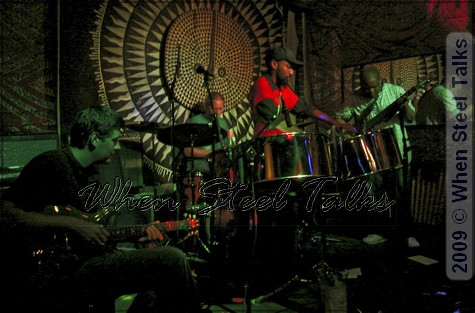
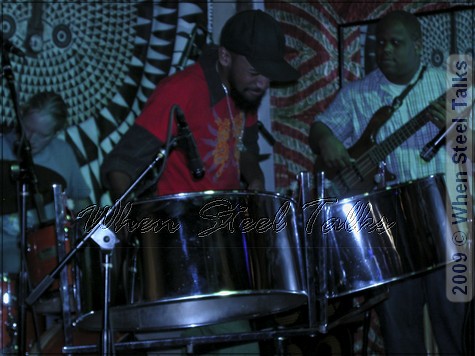
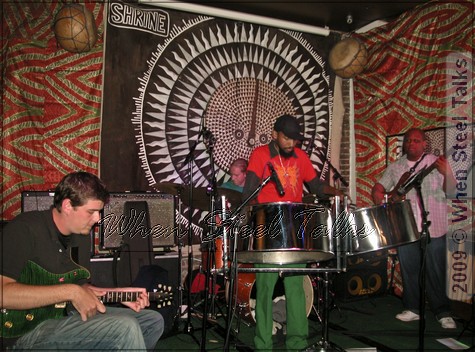
Jonathan Scales plays a voguish style of pan. And he does so by articulating life and personal experiences that are crowned in a mélange of musical idioms and styles. Like the mix of instruments in the Panorama, each offers its own delicacy in a smorgasbord of sounds. But, with Scales, the buffet is spooned out as treats from his exotic mind. Here, try this, the band Jonathan Scales Fourchestra seems to be saying. Savor the flavor. And next thing you know he’s whetting your appetite for pleasure. Most times, though, he’s building intense pulses that are esoteric to the ordinary ear, though leaving the listener mesmerized by a welter of skills. Such wizardry brings to mind the admiration for a mason who cannot afford to whiff in selecting the right fit among a mingle-mangle of stones to produce that rare architecture of cobblestone homes. Indeed, when you look a it - or receive it - you’re left with a memento of his challenges. Scales, 26, married with no children, has just released a nine-track CD, Character Farm and Other Short Stories. You’d be missing out on a great opportunity to sample Scales’ precise compositions as well as the band’s novel and painterly expressions.
The following is an interview conducted a few weeks before the CD was distributed. It is accompanied by mini reviews of the new work.
Narine
-
What’s your creative process?
Scales
-
Sometimes it will start with just like a style. I might start with a rock section, then I would go into something totally different. Sometimes I lay out some ideas, how I want it to go, as if you’re writing a story. From there, I start crafting the music - like how can I write music to fit this form I’ve just written. The notes come later. First the idea then the notes.
Narine
-
When was the first time you heard a steel pan, and what was you reaction?
Scales
-
I may have heard it some time in my life without realizing it. A friend introduced me to pan in 2002, as a freshman student at Appalachian State University, in Boone, NC. They had started a steel band there 27 years ago, before I was born. I was studying music composition as a saxophone player. My friend committed me to try out for the steel band. I think I was really natural at it, and I took a liking to it. It was nonstop from there. It was more natural for me than the saxophone which I was playing since middle school.
Narine
-
Was it easier for you to extemporize on pan than on the sax?
Scales
-
Whatever we played on pan was all sheet music. It wasn’t like in Trinidad where they teach everybody by rote. But I wasn’t used to looking at the page and playing at the same time. I didn’t want to do that, so I memorized all the music. I was in the pan yard all the time just memorizing parts.
Narine
-
So you had a Trinidadian vibe, huh?
Scales
-
I didn’t know it then.
Narine
-
Do you have Caribbean genes other than the pan?
Scales
-
No
Narine
-
What was the name of the band?
Scales
-
The Steely Pan Steel Band. It was started by Dr. Scott Meister in 1984.
Narine
-
Did the band include Trinidadians?
Scales
-
Just American kids. Predominantly white school, but a couple of times we had a few African Americans in the group. It was a small band of 20 musicians.
Narine
-
Did you play for course credit or just performed with the band?
Scales
-
Students pretty much stayed in the band through college. I played until I graduated in 2006. We did a lot of shows in schools and colleges. So I got a lot of experience playing the pans.
Narine
-
Did you come across a video or recording of Trinidadians playing the instrument?
Scales
-
The band is very focused on Trinidad, so when I got into steel band that’s when I started learning about soca and calypso and the history of pan.
Narine
-
How did you receive the story of pan’s birth?
Scales
-
It amazed me. It changed my perspective on the instrument, because people associate steel drums with vacation, islands and paradise. I get a deeper meaning of the music.
Narine
-
How did the switch from sax to pan work for you, now that you realized you’d become a panist?
Scales
-
I realized it the first day, to the point I wanted to drop saxophone, but I couldn’t because steel pan wasn’t considered to be a major instrument.
Narine
-
How did your training in classical composition for the sax fit into your style on the pan?
Scales
-
That’s 99 percent of what I’m doing. I studied 20th Century composers like Stravinski, John Cage, Aaron Copland and Arnold Schoenberg (who pioneered innovations in atonality that spurred controversy in modern music).
Narine
-
Did you also study jazz at the university?
Scales
-
Not a lot of jazz artists, but on my own I started to listen to Miles Davis, John Coltrane, Cannonball Adderley and more modern jazz players like Chick Corea, Pat Metheny and others. As far as the classical training, that’s a big influence on my style. My composition teacher was the steel band director. He’s a progressive, modern thinker when it comes to music; very outside the box.
Narine
-
Has Dr. Meister ever been to Trinidad?
Scales
-
He visits Trinidad all the time. He’s very informative about the history and culture of Trinidad, and makes it a point to teach students in the band about his knowledge.
He takes them down there every couple of years.
Narine
-
Were you part of these groups?
Scales
-
I came in the summer of 2004. We spent two weeks at the UWI campus.
Narine
-
Did you visit a pan yard?
Scales
-
Yes. Trinidad All Stars.
Narine
-
Did you enjoy the experience?
Scales
-
As a composition student, I was really into Panorama arrangements. At the time my favorite arranger was Jit Samaroo. In college, we played some Panorama songs, like Pan in A minor. I like Kitchener a lot.
Narine
-
What did you learn in the pan yard?
Scales
-
I was inspired by the execution of the band. So with my band, we do a lot of rehearsing, keeping the music tight, like the Trinidadians do for Panorama. I was inspired by the unity of sound by the entire band. A lot of crazy notes playing together. That takes a lot of work. Tremendous work ethic.
What
They're
Saying
About
Jonathan
Scales
-jonathan scales
"...a Thelonius Monk-like attitude with a Mozart creativity that works..." - When Steel Talks
"...joyously inventive..."
-
Jazz Times
"At the end of the day Scales is going to be a major player in rewriting the books on steelpan music outside the box."
-
When Steel Talks
"Jonathan Scales brings new vitality to the traditional Caribbean instrument, picking up where Othello Molineaux left off 20 years ago with Jaco Pastorius."
-
Jazz Times
"...rising star of the steel drums..."
-
Traps magazine
"Jonathan Scales makes the pans fit in unconventional musical spaces. (4 out of 5 stars!)"
-
Modern Drummer
"Plot/Scheme, reveals a steel drummer who understands the musical world with scholarly precision."
-
Mountain Xpress
"Jonathan Scales' new album takes the steel drums even further from the islands"
-
Mountain Xpress
"PLOT/SCHEME is an innovative and energetic journey into what the steel pan can do in a modern jazz context."
-
Bold Life
"Scales lists one of his biggest influences as Bela Fleck...and the influence is most clear."
-
Up & Coming Magazine
"Jonathan Scales is a composer who uses the steel drums to push musical boundaries and defy classifications."
-
Asheville Citizen Times
"Refreshing originality with a plentitude of harmonic, rhythmic ,melodic and spiritual depth"
-
Jeff Sipe
"Jonathan is a gifted musician and a very talented songwriter. The sky is the limit with him."
-
-Joseph Wooten
"Do
not
be
fooled
by
the
restraining
title
of
Jonathan
Scales'
debut
release
[One-Track
Mind],
or
lulled
into
stereotyped
visions
of
happy-time
island
music
by
his
instrument(the
steel
drums).
Jonathan
Scales
has
a
lot
to
say,
and
he
says
it
eloquently."
-
Jazz
Times
“Character
Farm”
solidifies
Jonathan
Scales’
place
as
one
of
western
North
Carolina’s
most
innovative
and
creative
artists.
Not
only
as a
performer,
but
as
the
composer
of
all
the
music
on
the
album,
Scales
is a
groundbreaker."
-
The
Mountain
Times
Narine
-
What do you think of Clive Bradley’s arranging style?
Scales
-
I’m still connecting the names, the places, the bands. Usually, when I listen to Panorama music, I’m in it for the arrangements, because I’m on the jazz compositional side of things, so I feel like I’m in the middle of a couple of different worlds.
Narine
-
Have you met Len Boogsie Sharpe?
Scales
-
Never met him, but everybody tells me he’s the best.
Narine
-
I read reports that you remind purists of Trinidadian jazz panist Othello Molineaux, Thelonius Monk and Boogsie. Who are you, really; and does the influence of other artists creep into your work?
Scales
-
My biggest influence would come as a surprise to a lot of people. It’s [American] Béla Fleck (one of the world's most innovative and technically proficient banjo player, nominated in more categories than any other musician - country, pop, jazz, bluegrass, classical, folk, spoken word, composition and arranging).
Narine
-
Why?
Scales
-
He took the banjo and put a whole new spin on it; some really cool out-there jazz stuff. I kinda feel the same way about our band. My compositions pull from other areas other than calypso and Panorama, and music that would normally be associated with steel drums. Some people might think I’m not into that kind of music, but I love it. Say that you’re raised in Trinidad and you’re around calypso and Panorama all the time, you’re gonna be one type of panist. But me, I’m from a military family and I’ve lived around the world, with all the influences from the jazz side and growing up as an American kid listening to hip hop and rock, then studying the modern composition guys, so I just came out with my sound just from living my life experience.
Narine
-
A reviewer wrote that you’re like Jimi Hendrix for the steel drums. Do you see it that way?
Scales
-
I’m still getting into his music more and more, but I was definitely influenced by him as a bandleader. He and Miles Davis are my biggest influences as bandleaders. Hendrix was different in his era from other people of his race. Sometimes I feel like that. In fact, I’ve always felt different even from my family in Virginia because I moved around so much. Jimi was like that.
Narine
-
When you performed at Jazz artists on the Greens at the UWI Centre for the Creative Arts in 2009, what was the experience like?
Scales
-
That was my second visit to Trinidad, the first time performing my music there. I was concerned how Trinidadians would react to it. So I planned to be myself, not try to appease anyone. I thought, maybe I should try to play some Kitchener covers to mix in with my original music to break the ice a little bit. But I decided to just play my set.
I started off with Jam We Did. It was received really well. I felt like they instinctively understood what I was trying to do. I think the audience was glad to see an American taking their national instrument and doing something different with it. That show broadened my fan base in Trinidad. Some of them still contact me.
Narine
-
What did other panists say about your performance?
Scales
-
A few panists were talking about the phrasing of my ideas. It was all encouraging. I was blown away by Mikhail Salcedo and a couple of other Trinidadian panists.
Narine
-
What was your experience with the culture and cuisine?
Scales
-
I really wanted to eat roti and doubles, and bake and shark, which I ate plain at Maracas Bay. We got someone to take us around. We went to all the spots, visited some pan yards. We tried to squeeze everything we could do in two days.
Narine
-
I heard a piece of music today, Mind Your 3’s and 2’s. It commences with a pan yard mood and then explodes with your inimitable talent. How conscious were you about the yard when you wrote that?
Scales
-
The basic form was very mathematic. It’s a series of numbers and rhythms. The rhythm is thought out mathematically. What I tried to do is take these equation in mathematic formulas that modern composers would use to come up with progressive ideas. I started to think of the same ideas, but I wanted to make them accessible to the average person. Sometimes when you listen to modern compositions and modern neoclassical music you might not understand it because it’s not very interesting when it comes to harmony and melody. I try to bridge the gap with how they present harmony and melody with something that people can get into also. I didn’t do it on purpose, I don’t think. It just came out that way.
Narine
-
The song Desert comes off as an Arabic thread that stumbles upon an oasis of jams, as opposed to another spectrum, The Longest November, which is so new age, and in which there’s no intrusion at all, it’s almost classical. So what determines your range of styles?
Scales
-
Longest November gives credit to my studies as a composer in college. I studied minimalism, people like Steve Wright and other modern composers. I wrote Desert for saxophone at 15, while I was in high school. Never played it until I started my band and decided to give it a try.
Narine
-
What’s your system of naming the tunes?
Scales
-
At the time I wrote Longest November, for example, in November 2006. I was out of school and wasn’t working - just playing music for a living. But I had just two or three shows for the whole month. That was a long November. It was about a very sparse time, cold winter and not much money. That was the vibe.
Narine
-
You just kept playing and playing and now I see why. Let’s revisit Trinidad. Did you come away with a sense of renewed enthusiasm, say, more musically spiritual from the experience?
Scales
-
I wished I could have seen the bands playing their Panorama songs, but it was inspiring to come back to the US knowing that I went to Trinidad to play my own music and people liked it.
Narine
-
Do you hope to see a Panorama competition someday?
Scales
-
I’d like to, but I’m very focused on my career.
Narine
-
Would you arrange Panorama music?
Scales
-
Panorama naturally is a composition event. I feel like I have the ability to do it. I feel confident as a composer, but with the history and culture of Panorama, Trinidad, pan, I would never personally set out to be an arranger. Unless someone asks me to do so. It won’t be my mission.
Narine
-
Who manufactures your drums?
Scales
-
I’ve been using drums tuned by Ellie Mannette and his group.
Narine
-
What influences the way you dress for your gigs?
Scales
-
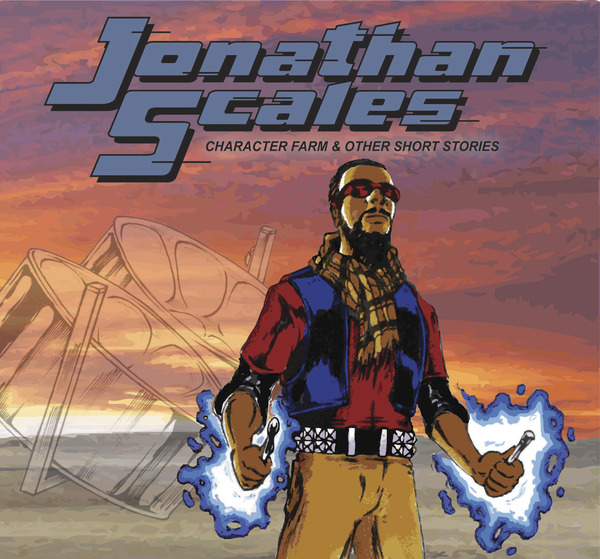
I dress to be free about myself in an eclectic way. I grew up like that. People are encouraged to be themselves in the art community of Asheville. I find clothing in thrift stores that I think is cool stuff. I wear a cut-off sweater with a shirt underneath sometimes. Robin Hood boots, studded belt, glasses. Occasionally, I’d raid my wife’s closet and find cool scarves.
Narine
-
If you’re planning another trip to Trinidad and Tobago, what do you plan to take in the most?
Scales
-
I want to be around when the Panorama season starts. To watch and see how it happens with the arrangers and the musicians. I definitely want to do that. Also, I want to go to Laventille. I’ve heard so many things about it that it becomes mysterious to me. People would say don’t go there. And I feel as if I should be there.
Narine
-
Thanks for your time. Best of luck in all your endeavors. May you make it up the hill one day. I’m sure Desperadoes will accommodate you.
Scales
-
I hope so.
THE ALBUM - CHARACTER FARM AND OTHER SHORT STORIES
Narine
-
About your new album, Character Farm and other Short stories, how did that evolve?
Scales
-
What spawned the idea - I have a friend who plays with Bela Flack...very forward-thinking guy. he was telling me back in the day people would write long form, like one big work, from beginning to end it was a single cohesive idea, and that today people have a collection of songs that they put together on CDs. He’d like to see someone writing a big, epic work that’s cohesive. So this is my attempt to use the steel drums to do that. There are still different songs but I have a vision for each, like a story or an idea. When you open up the album, each piece has a different illustration.
Narine
-
Let’s run down the list. Jam We Did.
Scales
-
When we play that song live, it gets very intense, and that’s a little bit different than the original use of the steel drums or what the traditional person thinks when they hear - or what they think of the steel drums. The video producer called it “slamming.” I like the energy. Done any faster, it wouldn’t have settled in as nicely.
Narine
-
Jay Sanders Singalong
Scales
-
I have a friend, Jay Sanders, a local bass player where I live in Ashville, North Carolina. We were at a bar one night and he had some drinks. He said, ‘Man your music would be more popular if you wrote simple melodies that people could walk away singing.’ A student at the bar said, no, Jonathan needs to do just what he’s gonna do. He doesn’t need to conform. I’m standing there and these guys are arguing about my style of music. I went home and wrote something with a nice groove but the melody is overly complicated. I did some metric things with the rhythm. Mostly, music is 4/4 time, but in this piece some bars are 13/16, 5/8, 8/8, 6/8, 7/8 and 15/16. Different things are changing around, but you can listen to it without having to keep track of the math part of it - so you can still feel good about it.
Narine
-
The Longest December
(There’s an interesting interplay of notes that gives the work a kaleidoscopic sound. Am I right, or hallucinating?)
Scales
-
No, that’s right. I wanted to have a song where I play the same thing the entire time, and I wanted the guitar and the bass to have a melody together. So there’s no distinct bass line. The bass line is the melody and the melody is with the bass at the same time. And there’s a hip drum beat that pushes it along. That was the idea for the song. I didn’t have the title at the time, but then I decided to throw in elements of the longest November. I started writing it in December 2009, and it was based around the problems I was having in my life at the time. A turbulent relationship with my wife back then - but everything is fine with us now. So it was fitting.
Narine
-
Character Farm (There’s an African vibe that kept loping around. What’s the connection?)
Scales
-
What really gives it that sound is the guitar, how it has a...like a single line comping (playing a jazz accompaniment). Usually, in American music when the guitarist is comping he’s playing a lot of notes at the same time. But in African music, it’s a melody on its own happening in the guitar underneath everything else. It helps along the rhythm with the drums to give it that vibe. I thought of Character Farm as a nursery rhyme without words. Think of it as an old lady who swallowed a cat to catch the bird, which she swallowed to catch the spider, which she had swallowed to catch the fly. Character Farm does exactly that.
Narine
-
Complete
Scales
-
I picked up my phone with a recorder on it and began to sing a melody. I was happy because my [earlier] album was completed.
Narine
-
Hallucinations of the Dream Chasers (Is that about the American Dream?)
Scales
-
Yes, it is about achieving a dream of being as successfully as you want to be. Having a fan base around the world who appreciates my music enough for me to keep a strong itinerary. It’s kind of a scary thing to pursue music.
Narine
-
Muddy Vishnu (What’s the mixture of composition and extemporization in your tracks?)
Scales
-
Muddy Vishnu is a mixture of two styles. One is Muddy Waters, the blues guitar player and the other is Mahavishnu Orchestra, a jazz-rock fusion group that performed in the 70s and 80s. They had forward ideas of the era. Their compositions were really difficult. So Muddy Vishnu is my take on the solid blues-rock of one artist and the complex jazz-rock of the other group. Most everything is written except where each instrumentalist has a few seconds to ad-lib.
Narine
-
Science Fair
Scales
-
It was one of my earlier pieces that I wrote in college in 2003. It was an experiment, mixing Latin with funk with the very composed unison lines, and there are parts with time-signature changes.
Narine
-
The Trap
Scales
-
Two ideas working there. In 2010, I was asked to participate in an event in Asheville, NC. It was about taking a compositional idea, which is the first eight notes of a piece, to see what four groups would do with these notes. I agreed to do it, then later the promoter said it was a volunteer thing. Which is fine, but he hadn’t said that when he called me. So I felt I was trapped into doing it. I wrote the piece in five minutes. I felt obligated to write it. When we performed it at the event it was a big hit. We got a standing ovation. In the end, I was happy we performed.
CD
REVIEWS
FROM THE
PAN
WHIRL
This is
an
outstanding
jazz
album.
The pan
is
clearly
the lead
instrument,
but it
blends
with the
other
instruments
to
create a
unique
sound.The
pan is
not some
exotic
thing
here, it
is a
musical
instrument
on equal
footing
with the
other
instruments.
The
music is
clean
and
crisp.
The
players
are
highly
proficient,
the pan
is well
tuned
and the
panist
is a
"crack
shot." -
GLENROY
JOSEPH,
pan
aficionado.
A
relatively
new
panist,
Jonathan
Scales
has
taken
the
instrument
into a
new
multifaceted
arena,
with a
blend of
instruments
never
before
tried by
the
steel
pan,
particularly
in the
genre of
jazz
music.
Character
Farm &
Other
Short
Stories,
Jonathan’s
latest
recording,
brings
to the
ear
shades
of the
Mahavishnu
Orchestra
and a
unique
blending
of the
pan with
flute,
guitar
and
fiddle.
They do
so in a
relatively
free-form
but
controlled
manner
that at
times
seems
both
simple
and
complex,
merging
contemporary
jazz
with a
taste of
hip hop.
Jam We
Did
gives
musical
room to
more
instruments
than
probably
any
other
steel
pan
recording
but
places emphasis
on bass
a la Jaco
Pastorius.
Character
Farm
with its
simple
melody
sounds
quite
African.
In a
rather
unusual
way the
bass and
pan
carry
the same
melody
for most
of the
tune
with
guitar
riffs
punctuating
rhythm.
In
Hallucination,
the pan
‘plays’
a bit of
a minor
role,
but
adopts a
unique
approach
to the
music -
‘grooving’
its way
between
the
soprano
sax and
tabla,
which
spices a
tune
that
takes on
a unique
East
Indian
and
Middle
Eastern
flavor.
It is
testament
to the
innovation
and
versatility
of Mr.
Scales
as a
composer
and
musician.
Science
Fair
is a
musical
lab that
experiments.
It
provides
a
controlled
mixing
of the
pan with
flute
that
tests
the
ability
of the
instrument
to be
showcased
in yet
another
nontraditional
manner.
Complete
also
features
the
guitar,
and bass
along
with
Scales
on pan,
which
sounds
like an
organ.
It very
well
could
have
been the
title
cut of
the
album,
which
indeed
is not
only
complete
but it
also
completely
stretches
the
limits
of the
pan.
Mr.
Scales
seems
destined
to be a
major
player
in
moving
the
steel
pan to
yet
another
level as
he waves
his “pan
sticks”
higher
and
higher
above
that
which is
commonly
referred
to as
Island
music. -
SKIPPY
LEZAMA,
host, 88
Jazz
Place,
Saturday
mornings,
WDNA
88.9 FM,
Miami,
Florida.
An
excellent
album.
Scales
approaches
the
instrument
in a
style
that
harkens
back to
its
African
polyrhythmic
roots.
He seems
to
understand
the way
pan can
use its
legitimate
voice in
a
conversation
with
other
instruments
similar
to how
the
conversation
flows in
a drum
circle.
Technically
he is
adept -
still
some way
to go to
really
be on
par with
some of
the
other
young,
gifted
panists.
But his
musical
voice,
his
compositional
voice,
stands
out.
I'll be
keeping
tabs on
him. -
DR. DAWN
K.
BATSON,
Chairman,
School
of Arts
&
Sciences
- Visual
Performing
Arts,
Florida
Memorial
University.
Scales
is
contemporary,
and he
had the
benefit
of an
environment
to
explore
a fresh
thing -
compared
to where
he came
from -
and take
it to a
different
situation
and be
unique
with it.
When I
hear him
play, he
listens.
A good
artist
is a
true
economist.
he knows
when to
give
color.
He deals
with
proportion
in
sound.
One who
doesn’t
dominate
the
overall
sound.
Sound is
regardless
of the
instrument.
Scales
makes
the
notes
sing in
a
different
way.
He’s
melodic.
Reminds
me of
Ray
Holman
and
Clive
Bradley.
They
don’t go
into
that
rote
Blues
scales.
You
don’t
put
butter
on a
roti.
You have
to put
different
ingredients
the roti
calls
for. -
DAVID
BOOTHMAN,
musician,
whose
latest
CD is
Sweet
Lime and
Passion.
click
for more
on
Jonathan
Scales
Dalton
Narine
is a
former
Trinidad
All
Stars
player
who is
currently
working
on a
novel
and
screenplay